
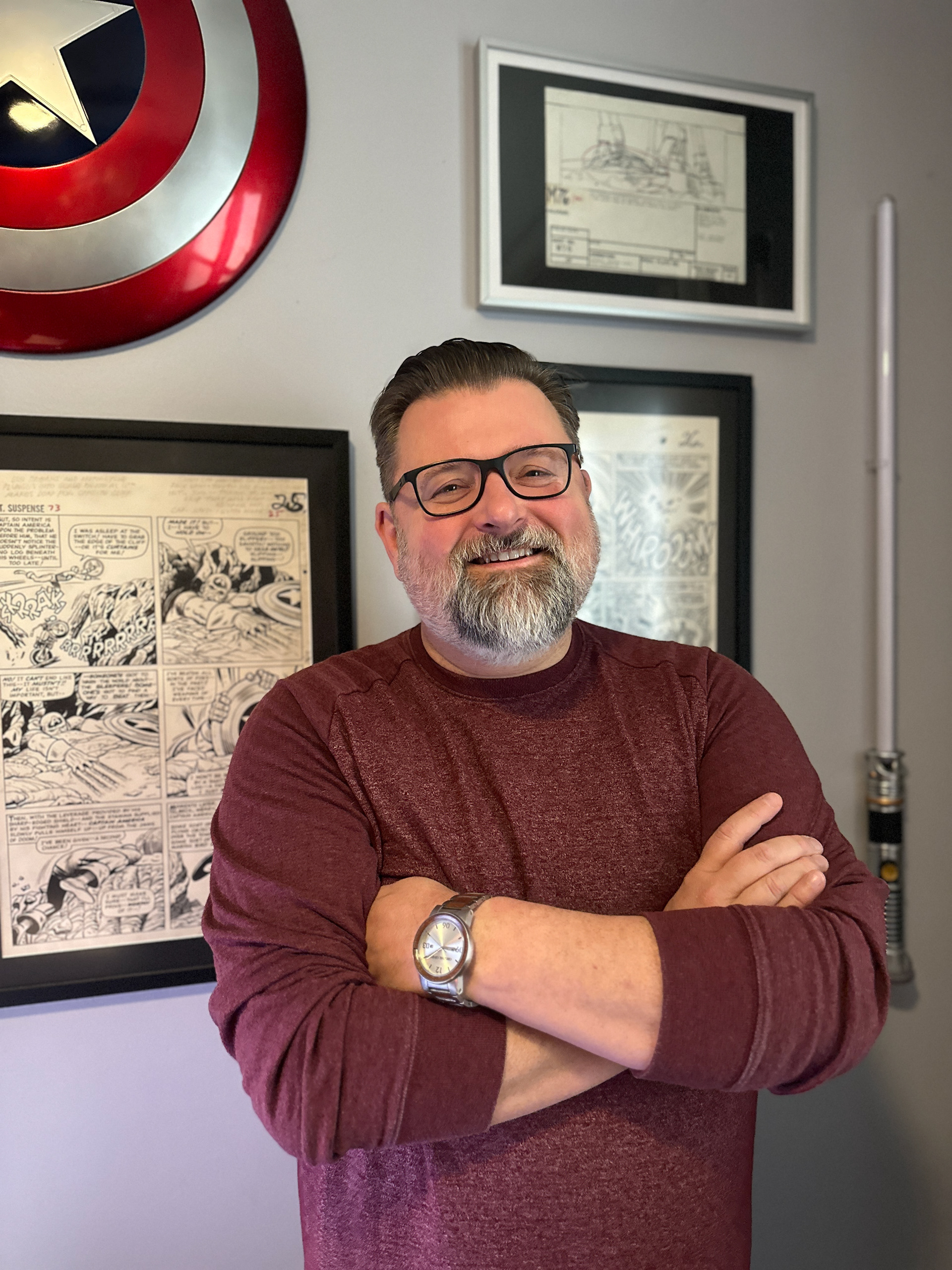
Luke Rolfes: We’re here today with Teague Bohlen to talk about his new novel from Blackstone Publishing called Escaping Denver. This fast-paced, action-packed sci-fi thriller is based off the theories and lore of the Escaping Denver podcast created by Mike Howorun and Brady Roberts. It’s so much fun to read! Thanks for hanging out with us today, Teague, and congrats on the new book!
Teague Bohlen: Thanks man. It was a lot of fun to do. A good break from the literary fiction I usually write and read for Copper Nickel for sure, but the 13 year old in me that used to love fantasy lit was having a great time reasserting himself.
Teague Bohlen: Thanks man. It was a lot of fun to do. A good break from the literary fiction I usually write and read for Copper Nickel for sure, but the 13 year old in me that used to love fantasy lit was having a great time reasserting himself.
LR: Can you talk about the process of tackling this project. What was it like building a novel out of something that already exists?
TB: Very different from my own writing, but in a super interesting and fun way. When I got hired by Blackstone, they wanted something along the lines of “a novel-length chase scene,” which might not be a direct quote, but it’s close. One of my challenges was to make a reader care about these characters enough that the chase meant something, right? That there was an emotional underpinning when some of this amateur-sleuthing gang meet an untimely demise, or reveal their secrets. And, of course, I had to stay true to what the podcast had set up. As a writing endeavor, it really became something of a creative puzzle for me: I was given mile-markers in a narrative, essentially a beginning, middle, and end with a few specifications along the way. But how I connected those dots was ultimately up to me, at least to present to the team for a thumbs-up.
LR: Can you talk about the research you had to do in order to feel like you could write in this universe with authority?
TB: That was a huge part of the process, and honestly my first stop. I came into the project knowing that I had to essentially interview the creators of the podcast narrative, to get a good sense of what they were envisioning. I mean, this project was essentially work-for-hire, so I had to give them what they wanted in terms of vision. But it was also a very open and collaborative process, for which I’m grateful to Mike and Brady. They were totally cool with me bringing myself as a sci-fi/fantasy fan—and a lover of conspiracy theory and cryptids!—to the creative table. So I ended up being able to put a lot of myself in there—stuff that’s always haunted me, like terrifying jackalopes and that strange transmission interruption in Chicago back in the 80s. Even some D&D references, sort of as easter eggs.
LR: When I was younger, I remember reading a trilogy of Star Wars books by sci-fi writer Timothy Zahn. I think these three books are known as the Thrawn Trilogy. Some say Zahn’s books were responsible for re-energizing the Star Wars fanbase and creating an expanded universe. Did you feel like you were doing something similar with your novel—expanding the boundaries of the Escaping Denver universe? How do you see this book in relation to the podcast? Did you consider this project to be an adaptation, or is it more like a “borrowing of a context”?
TB: I read those books too! I think almost every Star Wars fan of a certain age did when they came out. They were so good—not only fun, but also just satisfying to read more of the continued adventures of these characters we’d grown up loving. I didn’t really think of the comparison at the time, but I think you’re right, it’s very similar. Playing in someone else’s sandbox is a lot of fun, but there’s also a lot of responsibility to it, and I took that seriously with Escaping Denver. You can’t just come in with your shovel and knock down the castles that have been built, to torture the metaphor a bit. You have to build around what’s there. You’re not resetting the table; you’re bringing another table over that will hopefully line up with the first, so you can invite more folks to the feast.
LR: Did you look to any “adaptations” or “universe expanding” books as models for Escaping Denver?
TB: I didn’t specifically, but that’s probably because I had a wealth of experience with that sort of thing in my own reading history. I grew up on fantasy lit and comic books, both of which often involve the adaptation of someone else’s work. Heck, comic books are inherently that way, as creative teams change over time; Jack Kirby and Stan Lee invented the Fantastic Four diegesis, and then Romita and Buscema took over when Kirby left after issue 102. Then Roy Thomas took over the writing when Stan passed it on not long after. And on, and on, with new creative teams each adding to the world, trying (mostly) not to alter what’s come before. In terms of books, you can see the same thing with new Conan yarns being done by other authors in the 80s after Robert E. Howard’s original stories had been collected in 60s and 70s paperbacks. It’s a long literary tradition, really, in the wider scope.
LR: Just so folks have a context: Who the heck is this Collective, and what do they want? Can you give us the quick version?
TB: Ha! The Collective is that quasi-governmental agency that rules a vast and powerful network of operatives for the sake of power, as well as other inscrutable ends. In the case of Escaping Denver, it’s also an object lesson: it’s a force created to protect Earth from interstellar invasions, only to become more despotic than the aliens against which it was formed to fight. If only that lesson weren’t so applicable to current American politics.
LR: I wrote down this question ahead of time because I’ve been to the Denver airport, and I know there is this weird “demon horse” sculpture there with glowing red eyes. (I think people refer to it as Blucifer.) I gotta know: Was that an inspiration for the original conspiracy about the Denver airport in any way?
TB: Blucifer’s real name is “Mustang,” but yeah, everyone in Denver just calls him Blucifer, partially because of his demonic eyes shining in the Colorado night, but also because it literally fell on and killed its creator as it was being finished. Truth is stranger than fiction, right? I won’t spoil anything for those still happily winding their way through the podcast, but good ol’ Blucifer plays a role in Season 5. I think the weirdness around the airport—of which Blucifer is certainly a part—definitely played a role in the creation of the storyline overall. The podcast team—who are Canadian, by the way, and who’d never even been to Denver until after season one—says that the idea actually came from a YouTube video they’d seen about the mysteries beneath Denver International Airport.
LR: Do you have a sense how widely known these conspiracies about the Denver airport are?
TB: More widely known than I realized, clearly. I thought it was just a home-town thing, but even putting the podcast aside, lots of people both nationally and internationally seem to have heard of it to one degree or another. There are two things working here: one, that people love weirdness. And two, that DIA really did invite a lot of this in some of the odd choices they continue to make. Like for example, they just announced that they’re going to open the tunnels under the airport for people to visit—these tunnels where supposedly the lizard people live, or whatever. And of course, the internet’s immediate response to that is to conjecture that they’re opening this fake “show” level in order to distract us and convince us that there’s not MUCH more going on beneath that. Myth is a juggernaut. You can’t stop it. It immediately excuses itself from rational explanation.
LR: You write action incredibly well. In turn, sci-fi thrillers tend to be action-packed and plot-heavy. What are your thoughts on “writing action”? Must a writer continually challenge themselves to make more connections and raise the stakes to even higher levels?
TB: I appreciate you saying that—action sequences are a tough thing. Such a balancing act, to show enough so that a reader isn’t lost, but not so much that it reads like a list of sequential moves that just get boring to slog through. It’s always occurred to me that the action stories I’ve loved aren’t really about the movement, but about the moments that happen during the movement. So I focused on that, and in making the violence seem real. That meant a lot of it happens pretty quick: one of my friends mentioned that one of the characters getting slaughtered by the man-eating Piasa Bird of midwestern myth happened too fast, that he thought that character should have made a better showing, a longer fight. And maybe he had a point, but I made a lot of the deaths in the book fast as a nod to the “realism” of something like this. Even a trained combatant isn’t much challenge to a monster.
In terms of constantly raising stakes, I think yeah, that’s what novels do, right? I talk to my students about books not being one story, but a “chain of promises,” which I’m stealing from someone I read somewhere in my education. There are big promises and small promises that books make to draw along a reader. A story can have a single promise. A novel has to entice us with little treats along the way to keep us moving forward.
LR: Another craft question: At times in this book, you are dealing with a large cast of characters all moving together on the same journey: Jessie, Carla, Otomi, Jace, Walt, Alton, and Toby. As a writer, how do you manage such a large cast through action-heavy sequences?
TB: Again I must defer to my past experience in reading fantasy novels—I mean, look at the cast Tolkien’s books hosted, or the Dragonlance series (one of my youthful favorites), or Lloyd Alexander’s Prydain books. But honestly, it’s partly that I grew up playing—still play, when I can!—Dungeons and Dragons, where you’re telling a story as a group. While I was writing Escaping Denver, I thought of that strategy I’ve often used as a Dungeonmaster (man, I’m pulling back the nerdy curtain here, but let’s go): a good DM gives every character an opportunity to shine in the storyline, and sometimes moments won’t spotlight all characters. Give everyone something to do, which is where the banter can come in that works so nicely in character-building and humor too, but it’s okay for certain characters to be foregrounded, and others backgrounded, so long as that switches up here and there.
LR: This book explores online relationships. How closely do we really know folks who we don’t see IRL? This group of conspiracy theorists know each other intimately, yet they, at times, think of each other as expendable. Other times they don’t know what to think. How did you go about navigating that relationship?
TB: This was an interesting conundrum for this group of characters, that only a couple of them really knew each other in the physical world. Part of the fun is them getting to know each other in this new way. And you’re right, there’s an emotional component to it too, which was key in having such a deadly environment. Losing someone you’ve known online for years but just met in real life two days ago—that’s a different thing than seeing someone you’ve known in-person for years suddenly get killed. It’s something that we’ll all face, if we haven’t already: the loss of someone we feel we know, but only (or mainly) online. It is different. And it can be surprising either way, too, whether it's more or less affecting than one might think.
LR: This novel features gruesome deaths, often at the claws or fangs of some pretty nasty cryptids. How did you go about choosing which of the monsters of lore made their way into this book?
TB: I got almost complete freedom for this one, which was a ton of fun. Some of the beasties I drew from the podcast, but most of the major players in the novel were ones I got to bring to life. Some of them, like the Piasa Bird I mentioned earlier, were from my own childhood memories—the Piasa is a legend from Alton, Illinois, near where I grew up. Others were just favorites of mine for various reasons, or seemed to fit with the theme. Cryptids are great because really, you can do anything, but you usually don’t even need to—there always seems to be a local legend from somewhere that’s better than any scary abomination you can think up. That research was pretty fun.
LR: Did you leave any cryptids out that you wished had made an appearance?
TB: Oh god, yes. A bunch of them. It’s probably my biggest reason for wanting to do a sequel, out of many. Monsters are just so much fun. It’s hard to stop.
LR: Circling back to action narratives for a minute, a movie that continuously gets a ton of love in “best of” lists is Die Hard. The protagonist in this film is supposed to be a pretty regular dude—John McClane—who is put in a tough spot. As well, the setting and starting conditions of the story are what I think separate Die Hard from some of the other action narratives: it’s Christmas, in a high-rise building, McClane doesn’t have any shoes on, he can only communicate through a radio, etc. I’m curious: Were you inspired by any action/adventure narratives when building this book? To my ear, there is a little bit of Die Hard in here. A little bit of Aliens. Probably some Goonies.
TB: I was drawing from so many pop-culture sources in this book—that was one of the directives from the podcast creative team, and something I tend to do in my own work too, just naturally—that I’m sure there are echoes I didn’t even intend. There’s definitely a little of all those flicks in Escaping Denver, and more too. One of the epilogues is very Terminator-inspired, for example. There’s a lot of X-Files influence in the original podcast, and that shows up here too. The dialogue between characters is probably influenced by Firefly and the MCU. The fantasy/sci-fi genre is such a delicious melting pot; readers love when they see the influences of something they already love in another project. It’s a way the readership feels like they belong, and it should; it’s all invitation.
LR: The crew navigating a complicated underground fortress reminded me of a bit of videogame narration, as well, or perhaps an extremely difficult escape room. Did you draw inspiration from either of those two forms of storytelling?
TB: I’ve only done a couple of escape rooms, but video games have been one of the media that’s defined my life as a Gen-Xer. So yeah, I’m sure that snuck into the book as well, especially more modern games which have really invented a whole new form of storytelling. Some games are more about the story than the playthrough anymore, and some games are just so damn good that the depths of what you can do—and what the game is made to respond to in unique ways—is gobsmacking. One of my favorite games of all time is Red Dead Redemption 2 for this exact reason. Other media are only just starting to figure out that games are a treasure-trove of material. Fallout is only the start.
LR: I love the soundtrack you included at the end. What made you think to include that?
TB: I make a soundtrack for every book I write; this is just the first time I’ve shared it with the reader. Music has always been central to my process; sometimes I’ll put a song in a scene and then play it while I write that scene. Even if I eventually take the song itself out of that scene, its artistic influence hangs over the writing like an insistent ghost. So it seems only right that I give the ghost its due and list those songs at the end.
LR: What are you working on right now? Will there ever be a sequel to Escaping Denver? Would you like to go back to that universe again?
TB: I’d love to write a sequel to Escaping Denver. I have plans for it, and hopefully it’ll happen. I’d love to see this first book translated to film too—I think it would be an incredible visual treat just based on what the podcast team created.
But that’s still in the “maybe” stage—right now, I’m working on four different novel projects at the same time. Finishing up a literary ghost story about love and loss, which is really what all ghost stories are about, right? Revising an Isekai-type fantasy novel that I created with a friend of mine. Talking with an original Atari game designer about a book about his early days in the industry, and all he invented. And finally another literary novel, this one set in the mid-90s, about identity theft, the meandering lives of Generation X, a mysterious death, and WKRP in Cincinnati. It’s my hope that I’m able to bring at least one of those fully into the world before I get to jump back into Escaping Denver again.
LR: Thanks so much for taking some time with us, Teague! This book is a blast! Check out Escaping Denver from Blackstone Publishing.