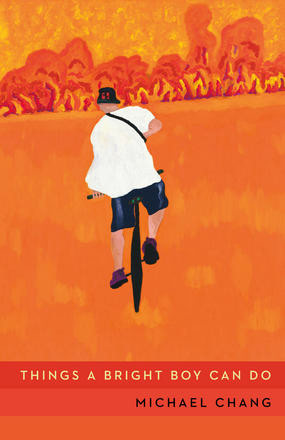

Luke Rolfes: We are talking today with poet extraordinaire MICHAEL CHANG—the author of many different books and chapbooks, including Employees Must Wash Hands from GreenTower Press, Things a Bright Boy Can Do from Coach House Books, and the forthcoming Boys of the Earth from City Lights. Also, the winner of the Hopkins Review's 2026 Anne Frydman Translation Prize (selected by Lily Meyer). Thanks so much, MICHAEL, for spending some time with us and talking all things poetry.
LR: Things a Bright Boy Can Do is available for purchase now, and then next year Boys of the Earth comes out. What can you tell us about the genesis of these two projects, and do you see them as related in any way?
MICHAEL CHANG: BOYS OF THE EARTH is a more adult sound, if that makes sense. It’s an organic sort of progression from THINGS A BRIGHT BOY CAN DO. They kind of orbit around similar themes and topics but I like to think of BOYS OF THE EARTH as more mature and grown up. I suppose their respective titles sort of suggest this, moving from the playground to the quad, so to speak.
Somebody once told me that you’re not doing it right if you aren’t losing some of your old fans with every new release. In many ways I’m still puzzling over that statement, but it seems like sound advice.
LR: A lot of folks who have read your work point to Frank O’Hara as an influence or lens to describe your writing. Who or what do you think of as influences?
MC: You’d think I’d be tired of getting asked about Frank in every interview, but I’m not. I respect what Frank did for poetry and admire how his work touched the lives of so many. I hope to be able to do something similar with my work.
I’ve been reading a lot of Jack Spicer, John Wieners, Joe Ceravolo, Bob Kaufman, Lorenzo Thomas . . .
LR: Your work and voice are incredibly original. The fresh language, the leaps, and the progressive momentum of your poems are always surprising to me, and yet they feel very much “YOU.” Do you set out with the intentionality of writing something unique, or are you just writing in the style that feels natural to you?
MC: I wouldn’t be doing this if I didn’t think I was offering something different. It isn’t some egotistical thing where I roleplay a poet. I see a lot of that out there, actually, people playing the sensitive, intellectual poet to meet chicks or whatever when in actuality they just write subway poems and poems about their night out. What I’m doing is so much more considered than that. I’m trying to put out work that moves people and entertains them and motivates them to go out and organize and volunteer and revolt against our current hellscape.
LR: You told me once you are not a big reviser. Is that still the case? If so, can you describe your generative process? How do you know when a piece is done and successful?
MC: I’m not a big reviser by definition because I only start writing when it’s more or less mapped out in my head. And then I implement cosmetic tweaks and slight word changes but never a sort of wholesale revision. I also don’t like sitting with my work for very long. I write it, then I send it out virtually immediately, so that doesn’t leave a lot of room for second-guessing and all that.
LR: I’m curious about word choice and selection: Do you think about word choice and selection much when writing, or do you focus on content? How do you balance the immediacy of current-day language (slang/lingo/text-talk, etc.) with the accessibility of “timeless” language?
MC: I appreciate the sentiment, but two different concepts are conflated here: accessibility and ‘timelessness’ are generally diametrically opposed. I’m not interested in timelessness—I actually think one ‘must-have’ in a good poem is the quality of immediacy and that’s generally defeated when people are too worried about ‘timelessness’.
A good poem manages to capture what I refer to as a ‘present sense impression’. The term comes from a hearsay exception which would address something like, for example, a panicked 911 caller describing a robbery in progress. A good poem for me captures that energy—it has to feel super current and relevant.
Having said that, I am interested in accessibility. I don’t think you should need a MFA to understand or enjoy or be stunned by a poem. We don’t need a cheat sheet to appreciate beauty in a landscape or in a person. So the idea that we need to decode a poem and how a poem is this sort of mystical thing really does a disservice to poetry at large—that’s why nobody reads poetry, they’re too scared to read it and if they are reading it, it’s insta-poem slop.
LR: One thing I’ve always liked about your work is how seamlessly you embed pop culture into your poems—celebrities, movies/shows, artifacts, etc. I’m curious: Do you usually begin writing about a specific topic and find a way to pull pop culture in, or does the inspiration come from pop culture and you ask yourself what other concepts/topics you can associate with that?
MC: I always start a poem with what I'm trying to say, what point I’m exactly trying to get across. That sounds circuitous or conclusory, but it’s really important for me to have a clear sense of where I’m going before I dive in.
And one of the many great things about living in Manhattan is that there is always ample inspiration. I don’t know how people get writers’ block in New York. Just leave your apartment, make a friend, talk to someone you don’t know, ask them about what they’ve been thinking about. Or—better yet—just sit and observe.
I play in another of my poems with this notion of ‘can you be a poet if you hate people’—and I think the answer's no.
Poetry is about people, and you have to be intrigued by people to study them and comment on them and critique what’s going on in the world.
I’m sure the haters will come up with counterexamples, but I sincerely believe most talented writers are at a minimum extremely engaged with this curious enterprise of personhood.
LR: Your poems are bitingly funny and razor-sharp in their critiques and criticism of modern life, culture, and politics. I love this, for instance: “Sometimes I read pretty words & feel absolutely nothing / [most poems] / Other times I’m submitting & the little voice says ‘don’t u think that’s a bit much’ / & I say SHUT UP MOM.” I’m interested in your thoughts on comedic writing. My philosophy is that something can’t truly be funny unless it is a little bit wicked—or maybe it needs to brush against the taboo. Do you agree with that? What are your thoughts on trying to write something funny? Is it even something one can do intentionally?
MC: Yeah, ‘wicked’ is a funny word. I like ‘menacing,’ too. I think my best poems always end on a slightly menacing note. Like when a guy makes a comment to you on the train and you get off at your stop and you’re walking home the whole time thinking, ‘hold on, was that fucked up or was that actually really hot?’
It’s tough to identify what makes someone laugh. You just have to—as Justice Stewart said—know it when you see it. An amusing relic from the terrible Bush years (they look almost quaint now) is the whole beer thing, right? As in, who’d you rather have a beer with? I think the best writers manage to coax that feeling out of people or convince them that they’re a good time. And humor is a great (the greatest?) way to get someone to let their guard down.
It’s equally tough to be authentic. I like that my poetry is authentic—i.e., it sounds like me—and also irreverent.
One of the cringiest things I’ve seen in other people’s poems is gratuitous swearing and oddly vulgar language. Now, obviously, I’m not against those things. But I do kind of look at the poet and match it up to their usual vernacular and go: hmmmmm. And then it becomes clear that the swearing is so forced and fake, the Steve Buscemi ‘fellow kids’ meme. Readers don’t like it when writers try too hard, and just as with any good New Yorker, their bullshit detectors are impeccable.
LR: I like how playful the form was in Things a Bright Boy Can Do. Some of the poems are long-lined and turned sideways. Some utilize tables and boxes. Can you talk about when and why you choose the form that you choose for a specific poem?
MC: The form is really something that develops organically as the poem is being written.
A big part of what bugs me about ‘project books’—I hate them—is that the form is kind of preordained. And that just isn’t effective or exciting to me.
Most ‘project books’ are cheesy and unoriginal because the poems feel forced into some existing style or format. These containers end up being a shoe that doesn’t fit.
When I write I generally start with an interesting image or phrase, as these things go. As the writing progresses I always check in with myself as to whether the shape of the poem is working for what I’m trying to accomplish.
And if it isn’t working, then I have to readjust the form and figure out what makes the most sense on the page. It’s a constant recalibration.
LR: I was intrigued with how you brought current poets into your work, such as in “Sexy Villain” and “Baby Drive South.” What inspired you to bring these folks explicitly into these pieces?
MC: I just saw the actress Sarah Pidgeon admit that she didn’t know who Jimmy Stewart was. I felt such secondhand embarrassment for her.
When you’re a creative or work in the arts or whatever, it’s a major gap if you don’t know what came before you. I hate the word ‘obsession’, but I think it’s a good shorthand for what must happen: having this zeal and fervency for the area or industry you’re working in. I really think that writing is a calling, and so accompanying that should be a religiosity and dedication to your practice.
A lot of poets (and people, really) are fighting to survive in this terrible world, so whenever you can carve time out to study the craft and eat and breathe it, it’s a beautiful thing.
LR: Another poem that jumped out to me was “Bing Chilling.” This piece features a call and response where you give us an image or idea in the left column, and then “X w/ Chinese characteristics” in the right column, where X is an explanation or interpretation of said image/idea. Can you talk about how the form dictated the content of this poem?
MC: I guess that poem is layered like a lot of my other poems. On one level there’s this yearning for an alternative to ‘Western style’ democracy, because obviously systems in the West, broadly speaking, have failed the vast majority of people. And a place that many commentators have pointed to, a place that’s doing it differently, so to speak, is China—adverse environmental impacts and human rights abuses be damned.
On another level—maybe in the other direction, even—is the Chinese perception of the West as this sort of supercop monolith that’s racist and terrible to its own citizens and interested in stamping out Chinese progress.
And the truth to all of these opinions probably falls somewhere in the middle, right? So the poem is my attempt to capture some of the push and pull of that very real dynamic.
LR: Your forthcoming book, Boys of the Earth, begins with longer, single-spaced lines. As well, a lot of the poems in this book are longer, in general, and tend to be single-spaced. There are even a few poems that are presented as prose blocks. Have you started writing longer poems recently? What drew you to select longer poems when building this book?
MC: I’m a poet who has many life cycles. For the new book I was in a longer-poem mood and so the works reflect a sensibility toward more thoughtful deliberation and a drawn-out kind of pace. When the next book comes along you can expect something else, another vibe. All of my books are sort of different flavors of really good ice cream.
LR: One piece I liked a lot was “HOUSE IN THE HAMPTONS.” This piece addresses AI and even the notorious DOGE worker known as “Big Balls.” You say this: “william carlos williams sez / a poem is a machine made of words / warhol sez i want to be a machine / TOO SLAY / andy, ur in luck !” As technology infiltrates our lives more and more—more and more people are using it—are you finding it easier to write about this topic or more difficult?
MC: I really think poets in general haven’t come up with a good way to write about tech. On the one hand, you get the weird sci-fi robot shit, which is fine, but kind of gimmicky and fake edgy. Like Turing tests and oooooo we’re all pixels. That’s not edgy, it’s just tired tropes dressed up as experimental.
On the other hand, you get the soap-box poets who are reflexively political, grandstanding and virtue-signaling. Evil in their own ways, and terrible for the art.
I’ve tried to write about tech in a suggestive way, in a style that’s not too on the nose, because nobody wants to be force-fed your opinion about tech. And, frankly, most people already feel one way—negative—about tech, so there’s no need to shout.
LR: I loved “TREE LIGHTING CEREMONY” which opens like this: “looking sly / deborah in the white dress / feeds her chicks into the woodchipper / there will be no laughing at the cotillion / but plenty of Ozempic.” That image or micro scene is wild. Where did that come from, and what made you choose to open the poem this way?
MC: With so many distractions and the sheer volume of poetry being published out there—particularly with the proliferation of online journals and so forth—I think you have 5 seconds to grab a reader’s attention. So I’m always sensitive to how I open poems and present things in a unique or unpredictable way, usually with some humor and bite.
LR: Another favorite of mine was the title poem—a piece presented as a block of prose. In this poem you jump from Proust, to Jennifer Coolidge’s character in White Lotus, to Sylvester Stallone’s turtles in the movie Rocky. You offer us this line, which could somewhat describe your writing style: “I generally refer to Tom Stoppard’s notion of ‘ambushing’ his readers—the writer needs to be constantly surprising, on the larger scale, with plot, but also on the much more granular level of the line. Sentences and phrases should never end up where they appear to be going.” What can you tell us about this poem? Is it, in a way, a microcosm of your aesthetic?
MC: To get down to brass tacks, surprising poems are the kind of poem I aspire to and that I like to read. I mostly want to write what I enjoy reading. And so it’s perfectly natural for me to chase this sort of element of surprise and elevate it in my poems. Most readers of poetry are (hopefully) practitioners or avid followers of the craft, so the challenge is writing at a level that makes things interesting for them. Like surprising experienced chefs with new flavor combinations or fresh techniques so they go: ‘oh!’
LR: You mentioned, too, that you recently started working in publishing. What can you tell us about that, and has it shaped your writing in any way?
MC: I love it. It feels like a natural step after several years of being an editor and guest editor. I am the new publisher at the avant-garde print periodical CHEEKS. And as someone who has spent literal hours in the car with me, Luke, it shouldn’t be surprising that CHEEKS has come out swinging.
At a time when print media is shrinking day by day, with little hope of reversion, I really wanted to plant my flag and say ‘hey, we’re committed to a physical object, a hand-held magazine’.
Besides, ‘publishing’ just feels like a catch-all term for the skills that I’ve developed as a poet and editor and networker. I think the networking piece of publishing is really undersung. It’s so exciting to meet people who are performing at such a high level. My role as publisher is to bring together the most interesting writers working today.
And, honestly, I spend a lot of time thinking about poetry and writing and so I’ve become really familiar with the oeuvre of the people I publish. For that reason, I’ve become determined to select work that is unconventional and surprising—for us and for them. I am happy when people push themselves to do something different, when they get into a mode that feels strange, ambitious, personal.
My job at CHEEKS is easy because I find writers I admire and essentially get out of their way. And when we open for submissions, I’m going to maintain that ethos of finding the best in class for lit. Fundamentally, CHEEKS is a magazine for writers.
LR: What’s next for you? Are you writing new poems? More manuscripts?
MC: I’ve been hard at work on translating from the Italian. In fact, I just won the Hopkins Review's Anne Frydman Translation Prize (selected by Lily Meyer). I’ve been studying the practice and archives of the exciting Italian poet Greta Rosso to curate and translate her work into English. Some examples are out or forthcoming in the Antigonish Review, Denver Quarterly, LIT magazine, Washington Square Review . . .
LR: Thanks so much for taking the time with us today, MICHAEL. Congrats again on these wonderful books, the translation prize, and best of luck with your future writing! You can purchase MICHAEL CHANG’S books here: