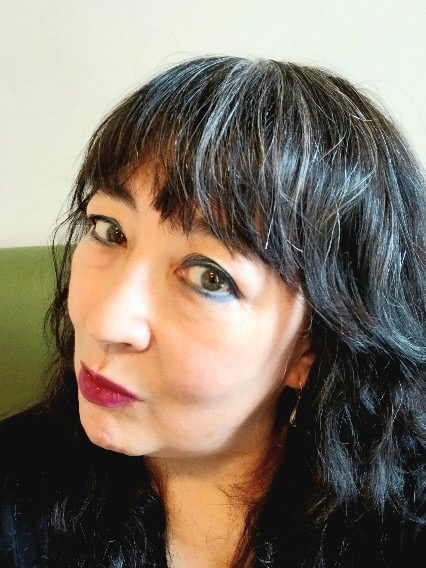
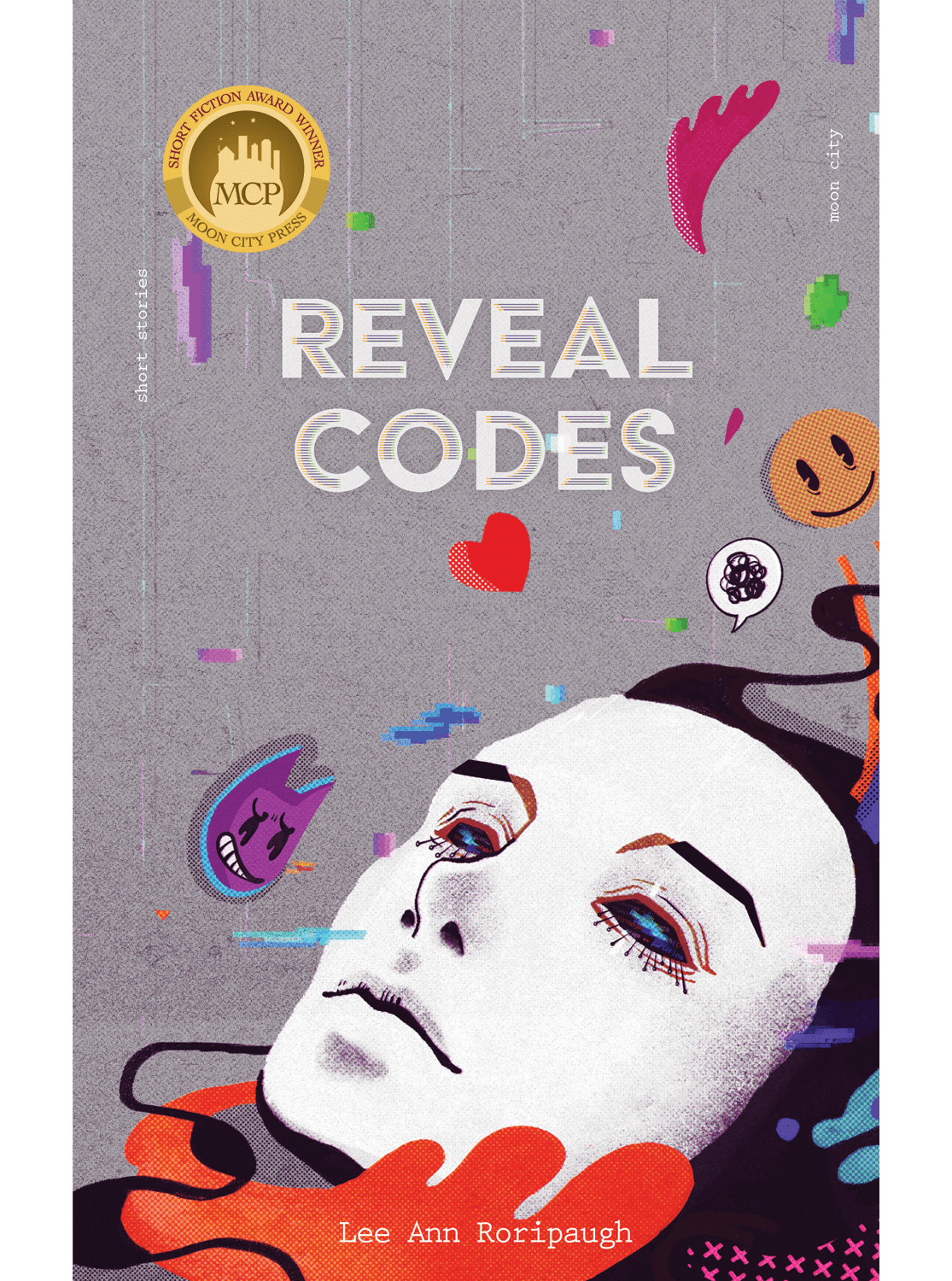
Luke Rolfes: It is a treat today to talk with Lee Horikoshi Roripaugh. Roripaugh’s collection of stories called Reveal Codes was the winner of the Moon City Press Short Fiction Award and is available through University of Arkansas Press. In these tightly woven and imaginative stories, Roripaugh takes us through everyday relationships with friends, lovers, and family members in nuanced prose. The characters in Reveal Codes navigate the complexity of human connection, how difficult it is to move forward when you simultaneously know the best and worst of the people around you. Thanks for taking the time with us today, Lee! I love this book! Can you give us a sense of the genesis of Reveal Codes? How long has this project been in the works?
Lee Horikoshi Roripaugh: Thank you so much for these great questions and the generous reading! This project has been in the works for a long time. Partly because I was working on the book at the same time that I was working on several poetry projects, as well as a collection of lyric essays, and partly because I tend to be a slower writer. The first story in the manuscript was written in summer 2012. I was lucky enough to have a month-long self-directed literary residency at Banff, where I made significant progress on conceptualizing and drafting the poems that ultimately went into tsunami vs the fukushima 50. At the same time, I very much also wanted to be writing short stories. I’d drafted, and then ultimately discarded a complete collection of short stories, some of which had been published in literary journals, and even though I didn’t feel the collection was ultimately viable as a book, I learned so much from the process. And I was thinking about how I wanted to write a shorter, crisper, more pointed kind of a short story and I’d also been taking notes on ideas, details, and gestures for these short stories.
That said, I didn’t make any progress on these new short stories during the actual residency. It wasn’t until the residency was over, and I’d taken the shuttle bus from Banff to Calgary (where I saw a wolf in the woods standing at the edge of the road!), and was settled into a discount airport hotel before my flight home the next day that the form, and tone, and narrative for the first story in the book, “Date,” announced itself to me. I think I was still carrying all of the beauty and creative energy of the residency with me, because I wrote the entire story in one sitting, in less than an hour, sitting cross-legged on the bed and tapping it out on my laptop with my eyes closed, which is rare for me (see slow writer, above), and the story just landed in my lap so easily. Over the course of that summer, I drafted several more stories, and I could see the contours for the overall shape of the collection. I continued working on the project for the next eight years or so—drafting several stories each year until the collection was complete—and then I revised the entire manuscript over the course of a year for continuity and began sending it out in the early 2020s.
LR: Your earlier books are classified as poetry. As I get older, I find the boundaries and delineations between genres to be kind of blurry—maybe even arbitrary. As a person who writes in multiple genres, do you have thoughts on this? Should we think of ourselves as poets and fiction writers? Just writers? Does it even matter?
LHR: When I give craft talks on hybrid-genre writing, I always like to say that I believe that genre is—yes!—completely arbitrary. And what I find particularly stultifying about traditional genre conventions is the way in which they function as a tool of capital: standardizing art into fixed categories for marketing and consumption. Suggesting that one “produces” art according to a set game-plan of rules and conventions. Hardening the categories of art into predictable patterns and borders. Also, categories are the tool of empire. I think that art should be unruly, should trespass boundaries, and freely cross borders.
The other thing about fixed boundaries and delineations between genres is that craft and technique, to my mind, should be portable between genres. For example, prose writers can learn much about discourses in associative leaping, imagery, sound, rhythm and patterning which are usually considered to be part and parcel of the poetry workshop. Conversely, a narrative poem is a kind of tour de force of plot and story—usually considered to be within the province of fiction writing. Similarly, poets don’t necessarily consider the implications of point of view, as well as narrative time and distance, in the same way that fiction writers, or narrative nonfiction writers, do—but I’d like to argue that this can be one site of overlooked potential in poetry.
LR: Is there much difference in your process in approaching a story versus a poem?
LHR: In both my fiction and poetry writing processes, I tend to rely heavily on notes, in which I gather ideas, snippets, lines, images, details, etc. These small pieces will sometimes start to gravitate toward one another, hopefully in surprising and unlikely ways, and then I’ll begin grouping them together as notes toward a possible new story or new poem. When I have enough to hang on to, I’ll begin drafting. So the process is similar, but the difference resides in the kinds of notes that might come together. For poetry, I tend to collect images, or sometimes sonically arresting lines whose meaning I don’t necessarily understand yet, or compelling details. For fiction, I tend to collect snippets of remembered or observed narrative, quirky details that reveal character, and resonant actions.
LR: Quite a few of the pieces are written in second person. What is it about this perspective that appeals to you as a storyteller?
LHR: I’m enchanted with second person because for me, it halves the narrative distance between first person and third-person limited omniscience—allowing the writer to take advantage of some of the aesthetic possibilities afforded by both points of view. What I mean by this is that second person point of view allows the writer to create a sense of a compelling, charismatic voice, as in first person, but at the same time the narrative isn’t inextricably bound to that voice. There’s enough narrative distance/space to allow for a wider narrative aperture on the story, and there’s also enough space to allow for more variety of narrative or tonal textures. I think there’s more leeway for lyric or linguistic artistry at the sentence level without worrying if it’s authentic to a first-person voice. But what I also particularly love about second person is the way that it invites the reader in and makes them complicit within the narrative. It’s as if, suddenly, the reader has skin in the game.
LR: I love how you write relationships in this collection. Your characters are analytical and self-aware. They recognize the flaws and idiosyncrasies of the people they care about. Sometimes knowing that a person can’t stop themselves from buying a pretzel from an airport kiosk means love. Sometimes answering a question in a cat voice means the opposite. I’m curious: When you write relationships, does conflict and disconnect between the characters come organically? Or is it easier if you plan where characters overlap and where they don’t?
LHR: For me, I feel as if the conflict and disconnect between characters does come somewhat organically. Personally, as someone who survived trauma, a toxic family dynamic, and who is also neurodivergent, I myself am frequently hypervigilant, or acutely aware of small shifts in the emotional weather of others, and I think this is something that probably informs how I think through the relationships in the book as well. But I also think that it’s in the moments of conflict and disconnect where you can most clearly see not only the inner workings of a particular relationship, but where you can see the inner workings of the individual characters—the baggage with which they enter a particular relationship, their trigger points, their vulnerabilities, and the ways in which they are reactive to or shut down in response to conflict and disconnect with their partner. It’s incredibly illuminating.
LR: The characters often refer to others by nicknames based off roles and characteristics: The Beloved, The Plagiarist, Neurotic Cat Boy, Mudball, etc. I like that technique in writing. How important are character names to you? Why did you choose to give so many of these characters nicknames?
LHR: Honestly, it’s in part because I find naming characters incredibly difficult! For me, when I’m writing fiction, the character’s name has to fit like a glove in order for me to fully believe in the character so that they can begin to become fully realized—to move, speak, act, and react independently on the page. The nicknames immediately create that sense of fit for me so that I can feel that the character is real. The nicknames also do some quick and dirty work, particularly in stories that are very short in length, with respect to characterization and the fleshing out of relationship dynamics. Because I honestly don’t think that Neurotic Cat Boy would be as vivid or fully realized as a character if he were named John, or Phil, or Chuck, yes?
LR: A lot of these pieces could be described as flash fictions. Forgive me, but I always ask this question to folks who write short things. When writing something short, do you imagine a more extended narrative, and the short piece is a slice of that? Or do you think of flash fiction as a squished story? A small story? Let me put it the way I sometimes describe it to my students: If you have a picture frame you are trying to fill with an image (flash fiction), and the frame is 2X2, does that mean that the image is a 2X2 cropping of a 10X10, a 2X2 resizing of a 10X10, or simply a 2X2 image. Is there even a difference in your mind?
LHR: For me, I really strive to achieve an organic reciprocity between form and content. In the same way that I believe one needs the right frame, and especially the right-sized frame, for an image, I want to select the right frame for the story. So I don’t think of my short shorts/flashes as being slices of a larger story (although there are some elements of story cycle to the collection as a whole), nor do I think of them as being cropped, or larger stories that have simply been shrunk down. When you embiggen a smaller image too much you lose pixels, and when you shrink down a larger image into a too-small size you can’t see the details. I aspire to find the right-sized frame for each narrative.
LR: Let’s take a look at a couple of these pieces! One of my favorites is called “Amphibious Life.” In it, the second person narrator is in a relationship with a man named Simon. This story features a backdrop of trauma. Simon is traumatized from going “frog-gigging” when he was younger, and the narrator is traumatized by losing their father in a freak accident. At the end, the narrator is overwhelmed with the sense that they must reveal all secrets to Simon—even if the secrets will hurt. So many of these stories are about disconnect. The narrator, at the end of the story, wants to break through this disconnect like pulling off a band-aid—to bare all immediately. What inspired you to end the story this way?
LHR: I think that learning to be in a relationship has a steep learning curve and that when we’re younger, we don’t necessarily know how to have difficult conversations, or how to be open or vulnerable with another person, even if we’re intimately involved with them, even if we love them. I think this learning curve is even steeper if we’re still carrying, or sorting through, the baggage of our own past traumas. For me, the breakthrough point of this story was the second person narrator realizing that she needed to speak openly, vulnerably, candidly to Simon as an important step to breaking out of depressive fog. This action of revealing secrets felt more important to me than whether or not the breaking of silence would repair or rupture the relationship. But also, I wanted to end the story right on that place of precipice: that place of not knowing what would happen next. For me, those are sometimes the most interesting moments in life, and in stories. I love open versus closed forms and I think it's because it creates a site of possibilities for both the characters, and the readers. A door opening as opposed to a door closing.
LR: In the title story, another second person narrator works as a word processor. The narrator is sad when the firm they are working for switches from Word Perfect to Microsoft Word, because Word lacks “reveal codes” that show an author’s intentionality. The narrator’s relationships, as well, lack these “reveal codes.” It’s the perfect job for this particular narrator at this particular time in their life. I’m curious: Did you start from the premise of a character working as a word processor or is that something that came to you later in the drafting process?
LHR: After I finished my MFA, I moved to Columbus, Ohio, with my then-partner, and I worked for four years—first as a word processor, and then as a legal secretary—for a large corporate law firm. And so I did start the story from the premise of a character being at an awkward transition in her life, working as a night word processor, and trying to find the “reveal codes” to make sense of her relationship and her life. So, yeah . . . that was a little bit . . . autofictional?
LR: How important are jobs when writing character? I’ve always argued that it’s one of the most important details for a reader to know.
LHR: I mean, we live in late stage capitalism, so even most “dream jobs” are inherently extractionist I feel. So even as a snapshot of this contemporary moment, jobs reveal the ways in which most people/most characters are negotiating with, resisting, subsumed by, or being flattened by their need to “make a living.” Jobs also inform a character’s circadian rhythms, sleep cycles, wardrobe, anxieties, body aches, and priorities. Most of us are also at least slightly different people when we’re at work versus when we’re at home, and these differences are fascinating when you’re thinking about writing character. Also, the work space is such a vivid and specific world, replete with unique scene and setting. Every job comes with its own culture, rules, habits, and rhythms. I agree that work has the potential to reveal so much about characters.
LR: “Semaphore,” another favorite, involves a daughter who is pushed to the limits by her parents to become a competitive swimmer. The narrator shows us, in stark detail, how damaging this pressure can be to kids. Can you tell us about your motivations for writing this piece?
LHR: This piece was also, honestly, quite autofictional. I really wanted to convey that feeling of despair, of desperately feeling stuck/trapped, of not having agency when a kid grows up in a house where no matter how much they desperately try to please their parents, nothing they do ever comes close to being enough. The pressure is damaging and stressful, yes, and there’s a point, too, where something inevitably cracks.
LR: Likely my favorite story in the book is called “Sundowning, with Fat Juice.” This is a heartbreaking tale that is difficult to read, as it details the impossibility of taking care of one’s parents near the end of their life. Lee, I’m thinking about the stories in this book, and I believe one of the reasons I like them so much is that you provide us a lens to simultaneously see the best and worst of characters. When things end, there’s not always an answer. Sometimes things just end. Life and relationships are messy. People and family are messy. Is that something you are cognizant of when you write—the messiness of life, for lack of a better term?
LHR: I absolutely think about the messiness of life, and when I talk about my interest in more open, lyric prose forms, that’s one of the reasons I give for gravitating toward these sorts of narrative structures. Life is complex, and messy, and to my mind frequently resists a linear, progressivist narrative with a definitive, neat closure. People, and characters, are never only one thing and they occupy their worlds in a variety of different, sometimes contradictory, postures. And yes, it’s the messiness that particularly interests me, I think, and I also love the way messiness, even when it’s sometimes dark or awful, frequently tips and spills into the funny, or the absurd.
LR: What’s next for you and your work? Any new projects on the horizon?
LHR: I’m currently in the process of writing my way into multiple new projects. Taking notes on possible new short stories, drafting some exploratory new essays, and pushing forward on a new poetry project that I’m currently envisioning as a speculative, dystopian novel-in-verse. I love working on multiple projects in different genres because I get stuck in one project, I can simply pivot to a different project, a different genre and focus on a completely separate set of variables.
LR: Thanks so much for your time and your insight, Lee! It was wonderful to talk with you about this stellar collection. Check out Reveal Codes, winner of the Moon City Press Short Fiction Award: https://www.uapress.com/product/reveal-codes/