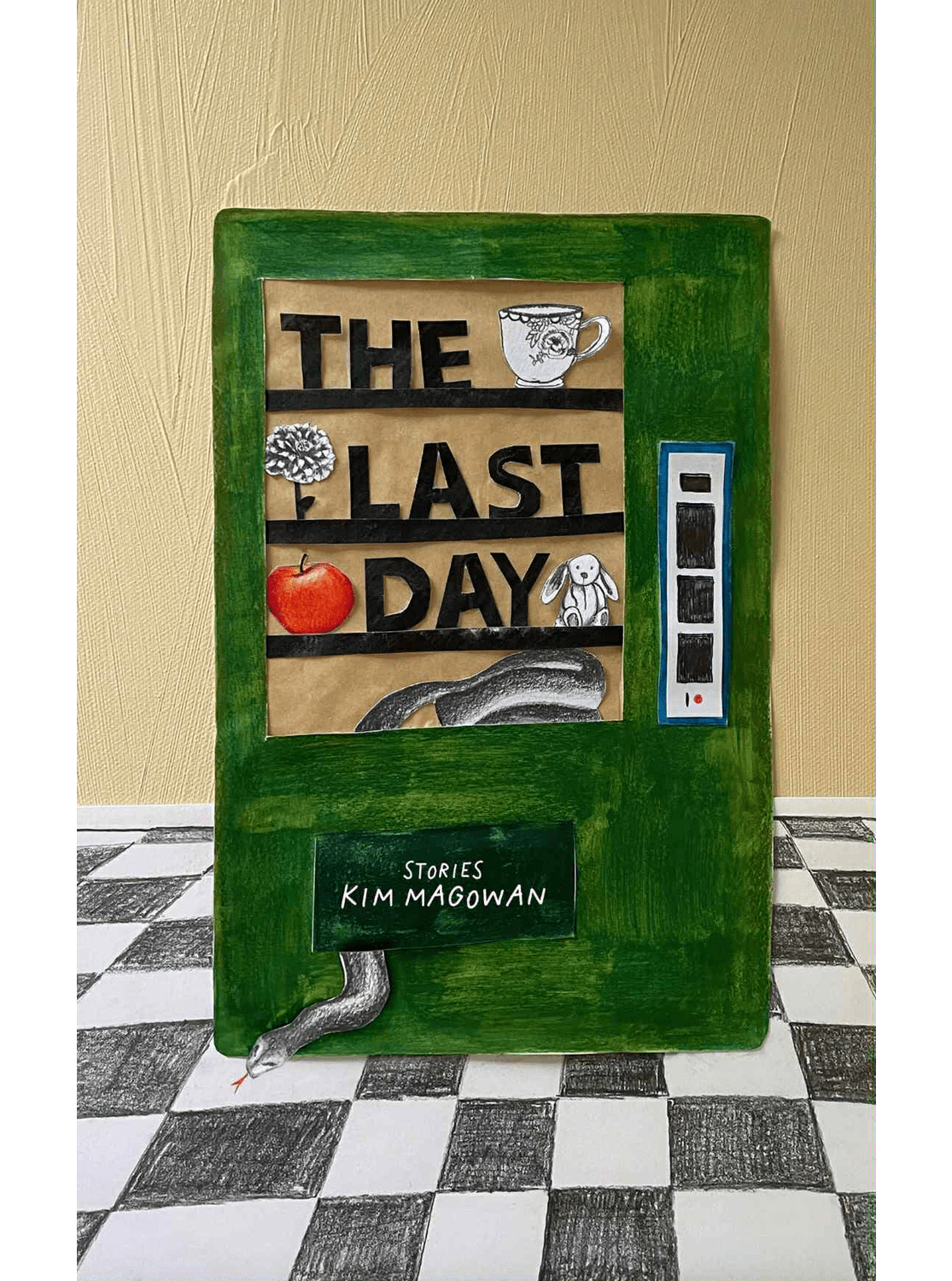
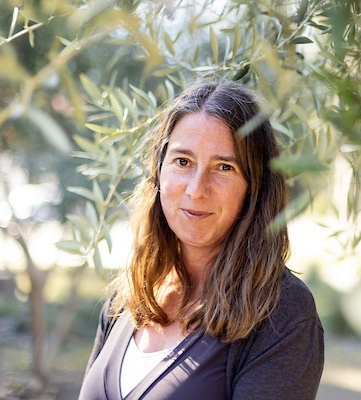
Luke Rolfes: I’m super excited to talk again with fiction-writer extraordinaire Kim Magowan about her stellar, brand-new collection of stories entitled The Last Day. Congrats, Kim, on this new collection, and thanks for spending some time with us today!
LR: Your first book won a contest from Moon City Press. (One of Laurel Review’s favorite presses!) The Last Day is from the same press but is part of the Editor’s Choice Series. Can you talk about how this project came into existence? Has it been a long time in the works?
Kim Magowan: My third book and second short story collection, How Far I’ve Come, came out in 2022. There are a few older stories and essays in The Last Day, ones that for whatever reason didn’t fit into my last book, but nearly all of these stories were written between 2021 and 2025. My first short story collection Undoing (2018) took me 30 years to write. This one was much faster. I’m hitting my stride.
LR: You’ve organized this book into four different, unnamed sections. What led to this choice? Can you tell us your intentions in how you organized/built this collection?
KM: There are 73 stories in the book, so I needed some way of breaking it up to keep it from being too overwhelming. The original title was The Problem Is (named after the story you published in Laurel Review, Luke!), and the sections at one point were lettered and titled: A: Partners, B: “Friends”, C: Family, D: Oneself. The concept was a multiple choice quiz: “The problem is [your partner]; The problem is [you].” At some point I abandoned both the book title and section titles—Mike Czyzniejewski, my editor, found the section titles too arbitrary, and the book title too general (“The Problem Is” applies to pretty much all plot-driven narrative). Mike moved two stories to the beginning and one to the end. But mostly, I kept the structure. The book is all about relationships under stress. The first section is about romantic partnerships, and a lot of them are unraveling—losing partners to divorce or death or disillusionment. The second section is about former friends, annoying or obnoxious friends and co-workers, ex-lovers. The third section covers all manner of family relationships—siblings, parents, children, complicated step-families. Again, there’s an emphasis on endings: the end of childhood, facing down the empty nest. The final section is more about observation and self-reflection, aging, the self in relation to the outside world. This section is where I put all the nonfiction (there are about 7 essays here, mixed in with the stories).
LR: One thing I’ve always admired about your work, Kim, is how well and realistically you navigate your characters’… pain isn’t quite the right word… perhaps a better word is disappointment or lack of self-actualization. The protagonists in these stories often seem like they bought a ticket on a train that appeared to be headed in the right direction, but now it is going south when they want to go north. Can you talk about explicating these characters’ lack of contentment? How does a writer express it in a way that feels true?
KM: Ha, “lack of contentment” indeed! That’s a great observation. A lot of my characters are trying to figure out how their lives got derailed. Sometimes, of course, the source is obvious—a beloved partner is dying, a husband is cheating, an adult child is estranged. These characters know why they are in pain, even if they don’t have any clue how to fix it. But sometimes, the source of the derailment is unclear, so some of these stories are about trying to pick out the moment where things went awry. Where was the clue in the past that this boyfriend was untrustworthy? Or that this relationship should have been nipped in the bud? What was the fatal error made with a child who now refuses to speak to you? And if one is unhappy, at what point is it time to stop persisting on this track (heading south, to use your metaphor), and jump off the train? I’m not much of a plot writer; many of my stories are about thought processes, characters trying to understand how they got to this point. Many of the books I love most, like Kazuo Ishiguro’s The Remains of the Day, are similarly ruminative. I think the key challenge of life is to arrive at self-understanding (“the unexamined life is not worth living”). There are so many impediments to self-understanding, like our natural human instinct to think well of ourselves, so to avoid dealing with our pettiness, selfishness, and bad choices.
LR: I need to ask about flash and micro fiction—a length you gravitate toward. What is it about this style of writing that appeals to you? Why do you find brevity to be the best vehicle for the stories you are trying to tell right now?
KM: The best way I have of explaining it is that just like runners have a distance that feels “natural” to them—some are sprinters, some are long distance, etc.—very short stories feel like my “natural” length. It took me years to discover this! I still occasionally write long stories, and maybe someday (never say never) I may even tackle another novel. But flash works for me, for a number of reasons. The main one is that unlike many writers, I don’t enjoy revising. Flash obviously requires a lot of revising, which for me is mostly chiseling, trimming away all the “fat.” But I don’t have to spend months and months grinding away at it. Novels are all about revision. I am a bit of a perfectionist, and flash appeals to that impulse of mine, to make something tiny and flawless: facet the gemstone. Most novels, including the very greatest of them, have bloat. Finally, I like the intensity of flash, the way it cuts immediately to the chase.
LR: When writing micro or flash, do you constantly search for ways to “get out” of stories rather than extending or following any specific thread? Is there something instinctual that tells you that you have reached the end of a short form piece?
KM: Endings are the hardest part of writing, I think, and as an editor I see that a lot of authors struggle with finding the right ending. The most frequent reason I decline a good story is that something doesn’t work about the ending. I hardly ever know my last line in advance. Sometimes the ending is purely instinctive—I’ll write a line and know this is where the story or essay needs to end (though often I need to fill in the transition to that ending, once I’ve got the landing). But often I end a story later than I should, so I need to walk it back. I don’t know if this is an issue for other writers, but in my first drafts, I tend to over-explain. I don’t initially trust the reader to get what I mean. So when I’m revising, I will frequently end up cutting the sentences that drive the point home, and find the line or image that points the way rather than spelling it out.
LR: Let’s look at a couple pieces! Your opening story (which is also the title piece) is one of my favorites. In it, a mom arrives at the last-day-of-school celebration for her child, knowing she must soon tell him that she and his father are splitting up. I always think of opening pieces as tone-setters for collections—and “The Last Day” seems to hit a lot of the themes that recur in this book: the despair of trying to love someone with your entire heart, feelings of dissatisfaction, inertia, and jealousy, etc. Can you talk about this opening piece and why you wanted to begin the collection in this way?
KM: That was all Mike Czyzniejewski’s idea, so kudos to Mike! Mike and I often exchange drafts, and when I first sent him the manuscript—the version called The Problem Is—it had different opening and closing stories. Mike loved “The Last Day,” and for the same reasons you mention, thought it was the right opener of the book. I was hesitant at first. “The Last Day” was one of my favorite stories, but it seemed more like a closer. But Mike persuaded me that the book is all about endings, so it made sense to start with a story that is focused on endings, and also the complex layers of endings: endings as both a happy and sad thing, a cause for celebration, a cause for sorrow. Another reason I like “The Last Day” as an opener is that it’s a divorce story, but you don’t know why the couple is divorcing. Well, hopefully the reader has thoughts about why, but the “cause” of their split (as if marriages have a single reason for ending) is not explicit in the story. And for me, that hearkens back to your earlier question—characters finding themselves heading in the wrong direction, on the train going south, and trying to understand why.
LR: I love “Boxes.” It involves a mother witnessing a strange interaction between a different mother and son on the BART subway. This piece seems to be about public perception, and the disconnect we have between others. I’m curious how the writing unfolded. Did you start out intending to write about this topic, or did the piece get there naturally?
KM: That is one of the oldest pieces in the book, and it’s nonfiction (though I guess that isn’t obvious). So, everything about that essay is true. I wrote it in March 2013, after riding on BART and witnessing the scene I describe. If I’m remembering right, I drafted it the next morning, so the BART commute was very fresh in my mind. It was one of my first publications. And yes, you describe exactly what that piece is about. My kids were still pretty young (7 and just turned 5), and I was very aware of scrutiny. At that point in my life, I bristled when I felt watched and judged as a mother, but I also (hypocritically!) watched and judged a lot of mothers. Fathers don’t come under the same ocular pressure, I don’t think. In my experience, being watched and assessed by strangers begins with visible pregnancy. A lot of it is well-intentioned (being offered a seat on public transit), but I’ve also had total strangers tell me I shouldn’t be carrying my two-year-old because I was pregnant. It’s like your body suddenly falls under some kind of social regulation. (Think about the judicial implications of the word “witness”). That essay is in the section of my book that concerns observations. What I was struck by on BART is how hard it is to understand what exactly we’re seeing, even when we are watching very closely, with what we imagine is our full attention. So I’m glad you like that essay, because it feels very personal.
LR: Several pieces in this collection resemble lists. “A Questionnaire for Men who Claim to have Excellent Gender Politics” is a numerical list. There is a list of body parts in “Index of Body Parts.” The micro “The Problem Is,” which appears in the Laurel Review, utilizes repetition in a list-like way, as does “We Tried.” What appeals to you about this technique of listing/repetition? How do you balance intentionality versus organic-ness when writing in a specific form like this?
KM: One of the reasons I love flash is that it allows me to play around with experimental forms, like lists—forms that would quickly get tedious in a longer story. “The Problem Is” and “We Tried” were both first drafted in these manic flashathons I do with writer friends, like Mike Czyzniejewski and Michelle Ross, where we spend 4-7 hours straight taking turns sending each other prompts every hour on the hour, and bang out a lot of first drafts. Both those stories came from one of my prompts, where I included some links to examples of anaphora stories and asked everyone to try their hand at anaphora flash (beginning every sentence with the same phrase). Actually, “We Tried” is the one story I can think of where I knew in the beginning exactly what the last words needed to be. I love anaphora, and I find it very useful in stories that are about cataloging and cycles, stories that cover a large expanse of time, stories that look backwards (as keeps coming up in this interview!). I love list stories too, for all those reasons, with this additional one: lists are narratives aspiring to the precision and causality of math. Lists, like geometric proofs, aim to prove something. They are thought experiments, but with an agenda, even if the agenda (as in a pro/ con list) isn’t pre-ordained. If a list story breaks its own rules, as in my weird essay “Index of Body Parts,” in which the last body part isn’t alphabetical, there needs to be an important reason.
LR: “Noelle Strodemeyer Sucks” is another favorite of mine. In it, you detail how we cannot help but compare ourselves to others around us. One of the reasons I like this piece so much is that it seems to hit on something that we, as a society, are currently grappling with. We see other folks on social media, for instance, and through their curated feed they look amazing and are having amazing lives. And then there is our lives. And our lives, next to theirs, kind of suck. Tell us about this piece and how you tapped into that spiral of “shame comparison” that seems to be working its way through society?
KM: Ha, I like that one too! Allison Wyss wrote a blurb for me that I love, that described my book as “petty in the most delicious way,” and when I read it, I thought immediately of this story. The narrator is SO petty, and she knows it, and feels a little ashamed of herself, but can’t help persisting with the pettiness. After I had my first baby, I joined a moms’ group, which I LOVED—I’m still good friends with some of the moms, and I relied on them all so much through the insanity of those first newborn months. So this story is pure fiction. I do think there’s something about being a mother—I talked about this already, regarding “Boxes”—that makes women feel both judged and judgmental. You’re constantly comparing your child to other children, and comparing your gracefulness and competence at parenting to other parents. The stakes of raising a human are so high, and especially with first children, we’re all winging it. We all feel insecure. And yes, yes, yes, to everything you say about the curated social media life! The thing is, even when we know that someone’s Insta or Facebook “profile” is artificial, filtered, we still compare ourselves and feel inadequate. One thing I just remembered about that story is that the editors of the journal wanted me to change the title, because they thought “Noelle Strodemeyer Sucks” sounded too immature, and I refused. The whole point of the story is that this narrator has regressed; she’s being a baby.
LR: A good number of these stories are set in the pandemic. What did it feel like to return to them, now that we are outside of that moment?
KM: When everything first shut down, in California on March 12, 2020, all I could write were pandemic stories. I couldn’t help it. I knew no one would want to read or publish them, but still: it’s where my brain was living, it felt like a compulsion. Most of those stories never saw the light of day, but “Blue Sky” and “The Terrible Daughter” were both stories I wrote in April 2020. People who have read my prior story collections, Undoing and How Far I’ve Come, might recognize Alice, Laurel, Nathan, and Nina (Undoing has four Laurel stories, How Far I’ve Come has one).
LR: The penultimate story in this collection is the surreal-tinged “The Last Faculty Meeting.” In the dreaded end-of-year ZOOM meeting, Jane begins a text-conversation with her dead husband. She then begins to contemplate if she herself is dead. Your stories generally are grounded in realism. What led you to bend the boundaries of reality for this one?
KM: I do have one ghost story in my How Far I’ve Come collection, from the perspective of Bluebeard’s dead wives: “Come, Come.” But yes, this is a departure for me, if one grounded in the prosaic world that you and I both know well (the endless faculty meeting). This is one of my favorite stories, and if I remember right, the idea came to me in a dream: what would it mean if a person you knew would not, because they could not, answer your text, suddenly responded? My new work-in-progress has more of these speculative stories—speculative both in the sense of having an element of fantasy, and speculative in that they germinate from these “what if?” seeds. I have a few stories in the new book about witches. One is more my psychological realism norm—the narrator’s daughter is writing a term paper on the Salem witch trials, and the narrator relates to how the trials targeted menopausal women. But two others are straight-up supernatural (a witch mother, annoyed with her children fighting, curses them; three sisters exchange their human hearts for stone hearts). So maybe this is my new writing path: embracing my inner witch. 🙂
LR: I love it! What’s next for you, Kim? Any projects upcoming?
KM: My latest work-in-progress is another short story collection, about 29,000 words right now, so still a long way from done. Once it gets to be around 50,000 words, I’ll start ordering it and curating it, but right now, it’s just a big, messy file that I throw all the new work into. This WIP is also mostly very short stories, though there is one story in there, “The Rules of the Arrangement,” that’s about 4000 words (and for me these days, that’s like Anna Karenina). As I said in my last answer, this book is a little more weird and magical. It leans more into speculative, in the ways I was describing above—fantasy, but also, thought experiment. One of my favorite stories in there is worst-case scenario thought experiment, “What To Do If Someone Tries To Tell You Bad News.” Because I’m a writer, no doubt, when I have a horrible, anxious thought, one any normal human would try to suppress, I will sometimes run with it: I’ll write a story that gives it free rein.
LR: Thanks so much for talking with us today, Kim. The Last Day is a fabulous book! Don't miss it! Out now from Moon City Press.
KM: Thank YOU, Luke! Always a pleasure talking to you!