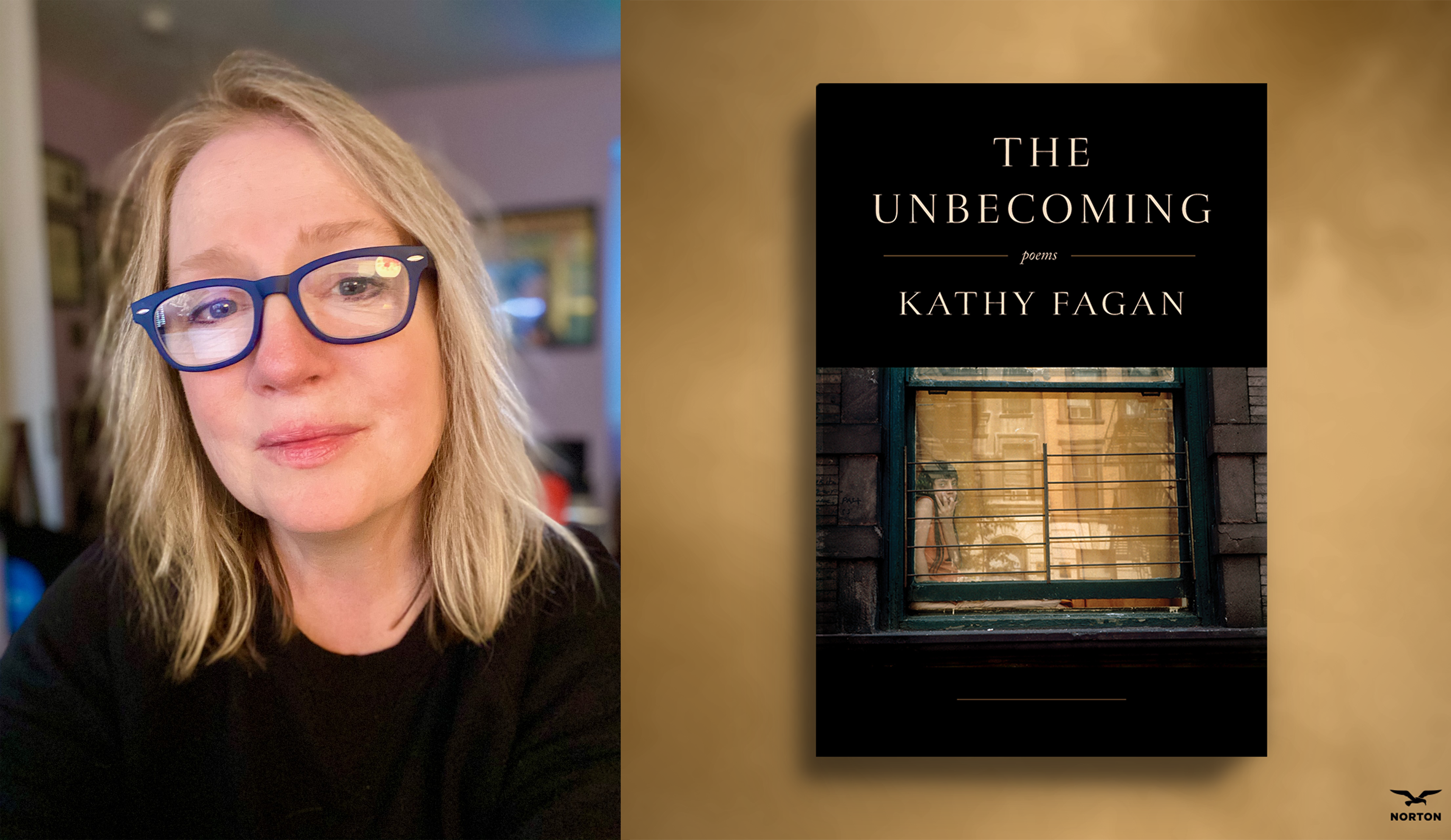
Luke Rolfes: It’s a treat to talk today with poet Kathy Fagan about her brand-new collection of poetry entitled The Unbecoming, releasing in September 2026 from W.W. Norton & Company. I love this book! It contemplates the cycle of life from sunrise to sundown, how we define and undefine ourselves, and the relationships we form between. It’s straightforward and honest, and it moves beautifully and organically between thoughts and images. I am also a big fan of Kathy’s last book, Bad Hobby, from Milkweed Press. These books seem connected in my mind—not as part of a series—but more like they are running a relay race, and The Unbecoming now has the baton. Or maybe they share the same heart?
LR: Thanks for taking some time with us today, Kathy. Can you describe the genesis of this project? When did you start work on The Unbecoming?
Kathy Fagan: Luke, first of all, thank you for the opportunity to talk about the book but thanks especially for your close and careful reading of it. Yes, I think it’s a collection closely connected to Bad Hobby in the sense that it moves through autobiographical territory. The Unbecoming focuses on what happens after: after middle-age, after the death of a parent—in this case the death of my father, around whom Bad Hobby was constructed—and after the realization that the entire world is in its after-phase, that it is literally failing, thanks to us (and billionaires), and here I am still writing poems. The book questions the desire to continue to create, to find in the aftermath something more akin to transformation than disappearance.
Poems for The Unbecoming started getting made in 2022, give or take, but in 2024, the notes I had for “Listening to Others” and “Blue Collar Devotions”—the sequences that frame the book—gained, I don’t know, energy or traction. In other words, they became poems, piece by piece. It was then I could see the collection as a book and understood, as much as one ever does, what it was up to. That it was the autobiographical sibling of the previous book, yes, but that its focus was outward rather than inward, more strongly embracing issues of class, sexuality, difference, and, most significantly, that the desire to make art from a mortal body in a dying world can be an honorable attempt to outlast both.
LR: Did you write poems specifically for this book, or did you cull poems from your already written work? Did you have to make tough cuts?
KF: My reply to your first question answers this one, in part. As to the tough cuts part of your question: absolutely yes! The visual arts played a large role in the making of this book for many reasons, but among the works of literature that influenced The Unbecoming I’d have to say that Louise Gluck’s Winter Recipes from the Collective served as a model for actually shaping the book as a whole. I’ve been reading and admiring Gluck since I was 20; luckily, I knew that I could never write a poem like hers. One can, however, learn a whole lot about craft from poets who are different from oneself, and Winter Recipes taught me two things especially helpful for The Unbecoming: the placement of poem sequences in a collection and the importance of volume in a book that deploys multiple modes of utterance. Sometimes it’s hard to make poems when you read scrupulously perfect poems such as Gluck’s—but it was very useful to me to read her final book as an architectural object so that I might draw up a plan of my own.
LR: The title of the book is simple, yet the idea of “unbecoming” is complex. It feels right for this text. How did you decide on it?
KF: The term appears only in “The Elevens,” during a meditation on conventional feminine beauty and behavior standards, and in the Pontormo poem as the speaker attempts to describe side by side paintings—one of the deposition of Christ from the cross, another of the Annunciation, both featuring Mary—in a tiny Renaissance chapel in Florence. When I was growing up it was common for parents, especially mothers, to scold a child, especially daughters, for their “unbecoming” behavior or appearance. I wanted to explore the juxtaposition of that peculiar use of the adjective and the noun it became in the manifestations of birth and death in the Pontormo frescoes; that resonated deeply for me as an aging childless woman mourning for her parents and planet. More than that, the word, as I conceived of it, became emblematic of the life cycle itself, and the ways we creatures shed parts of ourselves—in life, death, and all the spaces in between—so that we may transform into something new.
LR: A recurring theme is the absence of your parents, as well as the loss of your mother-in-law. I’ve heard folks describe the grief and lack of guidance that occurs after losing both parents as becoming an “adult orphan.” I don’t know if that is a good or bad way to describe it, but I can certainly resonate with the isolation in these poems, the feeling of being adrift. Did you do research into the psychology of loss in building this book? Did you speak with others who have lost?
KF: That’s the thing, Luke, everyone has lost someone irreplaceable, to death or breakup or illness or (waves hands) any number of other life changes. The book’s opening poem sequence, “Listening to Others,” references the genocide in Gaza, the Nazi and Allied bombings of Florence during WWII, and the destructive misogyny of—among others—the Roman Catholic Church. I wanted to acknowledge a commonality of loss in The Unbecoming. Feeling alone after my parents died wasn’t a fresh sensation—I was independent at 17—but to witness the processes of aging and death in loved ones over the past two decades has been a bracing learning experience. We’ll all face it—sorry, longevity influencers! But I don’t consider this book elegiac so much as clear-eyed. Empathy has become a pop term these days, and elder- and hospice-care have become corporate industries. The psychological and emotional toll on those who grieve is enormous, of course; I observed grief in this book adjacent to that toll but with a panoramic lens: the world and every living thing in it suffers—how we address that is what counts.
LR: One of the things I admire about your work, Kathy, is your honesty. Maybe vulnerability is a better word? You never hide yourself from the reader. I appreciate how candidly you express fear, uncertainty, loss, and grief in this book. We often discuss “writing about pain” in my classes, and students are always curious how a writer decides when the poem is for themselves and when the poem is for the outside world. What made you decide these were poems you wanted to share with the outside world?
KF: I keep a journal to write strictly for myself. For 15 years I worked with a psychotherapist to help unpack my personal pain and its history. Poems, or what I think of as real poems, are not unprocessed thoughts or feelings like journal entries or therapeutic discussions. Of course, poems are not processed thoughts or feelings either. They surprise me when I write them; all the poems I love best surprise me, each time I read them. That happens, I think, in the encounter between the reader and the experience of the poem. Like when I saw Pontormo’s deposition and annunciation in the corner of that Florentine church: I’d seen them before, I’d seen many versions of the subject matter before, as a former Catholic I’d been exposed to their stories before. It took that particular moment of attention to spark a profound unutterable understanding for me. I believe Pontormo and I worked together to achieve it, just as I believe that poets wish to work alongside their readers for that connection. Can and should you speak of your own sorrow in your art? Hell yeah, if you want to. The trick is making it art, and to do that takes devotion to, immersion in, and time with the craft.
LR: The season of autumn comes up several times in this book. You have poems entitled “October,” “Samhain,” and “The Light in Autumn.” Autumn, representing the colorful display at the end of the year, seems the right season for many of these poems to occur. Is it oversimplifying to label fall as the season where the world “unbecomes”? What drew you specifically to autumn?
KF: How lucky I am to have found such a smart reader, Luke! I frankly hadn’t thought of this, but you’re right: autumn, the unbecoming, that liminal time of year when the earth takes everything back to itself. And yet it is also the time of harvest, of transformation and renewal.
LR: Let’s take a look at a couple individual pieces. The first poem in the book is the lovely, multi-sectioned “Listening to Others.” In this piece, you move between past and present—with the imperative message of “run” as an undercurrent to this sequence. I am a fan of the ending. You relay a memory of your youth, how you had to shout so your father could hear you, and how, after he died, you kept his hearing aids. You say, “Sometimes / I bend to them and speak. Sometimes / I raise them to my own ears and listen.” What made you choose this as the final image of this poem?
KF: The 14-part sequence was written over six weeks of daily intense work in 2024. I was away from home, in a place that was both familiar and strange to me, and I had arrived with a handful of lines, which is how I often compose. What I couldn’t know was that the poem would become a sequence of poems, that it would encompass many (eventually) linked subject matters, or that it would manipulate syntax quite as much as it does. The discovery of these things propelled the poem forward for me in a way that allowed so much in, history and art and personal narrative as well as news headlines. That’s why I chose the hearing aids—an autobiographical detail that approached how I felt about what the poem was up to, feeling most powerfully one’s ever-changing impermanent self within a community of many ever-changing impermanent others.
LR: Another piece I admired was “Samhain.” These lines stuck with me: “I had thought that to be needed / was to be loved. / What, then, when nothing needed me? / And nothing did.” This is an incredibly heavy question. After reading it I had to set the book down and think for a while. I’m wondering if the process of “unbecoming” is how we amend our definitions, our perspectives on how we matter, what is our purpose, etc. Is this book, in a sense, a response to the question posed at the end of this poem?
KF: Yes. Thank you for this insight. The question I pose at poem’s end and its answer surprised me when I wrote them, and they still intrigue me a few years out, the double negative especially. So yes, I think the book tries to enact a rigorous self-erasure, a rehearsal of death. I understand why some people might find that notion morbid—it’s certainly un-American!—but I think it can be liberating to shed identity, and ultimately generous, perhaps, to accept one’s ordinariness while, as an artist, attempting to create something extraordinary.
LR: “The Light in Autumn” details an experience of a stranger weeping at a Kroger grocery store, likening the man’s actions to wailing or keening. This poem takes place during the height of the pandemic—everyone is wearing masks. Was this poem written during the acute stages of the pandemic or after? What is it like to think back on that time period from today’s vantage?
KF: This is one of the earlier poems from the book and I suspect it planted the idea of individualism and community that the book wanted to explore. The loneliness of that time for most of us was acute, and its rate of illness and death affected almost everyone—my own father eventually died of covid, while in hospice, and I unknowingly caught it from him… I only quit masking last year, and I still mask on airplanes and in large crowds. My opinion of humans during that period sunk to new lows even while my care for them grew. What do we do with the knowledge that we can neither protect nor be protected? A global pandemic, the rise of fascism, the ascendance of the wealthy and their ongoing deliberate annihilation of the powerless? Many of us, especially white Americans, hadn’t experienced that level of vulnerability before. But much of the world already had, for many centuries, none of it was new. “The Light in Autumn” tries to grapple with those larger issues on a personal scale in a quotidian setting—where better than a supermarket?
LR: Another favorite is “The Dream Won’t Come True,” which falls into conversation with the classic 80s song “Sara” by Starship playing from the speakers of the local Sheetz station. I’m curious about the genesis of this poem and how it came into its final form. Where did it come from?
KF: Daily life and the realization, while performing a mundane American activity like going to the grocery store or filling your car up with gas, that death is coming for us all. Just today I read a New York Times piece in which various senior celebrities are asked about aging—what it gives and what it takes away. Bob Dylan said that what age gave him is “freedom from the lie that anything was ever under control.” My poem runs up through at least five decades, from the Bronx in 1970 to the suburban Midwest in the 2020s, and hauls Robert Frost in, too, specifically his poem “Fire and Ice,” written over a hundred years ago. Folks were discussing the apocalypse even then—why have we allowed its hastening? Or was it never under our control? I was fascinated by Starship’s various band incarnations and shifts in style and persona as I researched this poem. Like our ferocious imperative to live, no matter the odds.
LR: The book begins and ends with multi-sectioned poems. The last is called “Blue Collar Devotions.” The final section is triggered by a text message from an unknown contact that asks, “Where are you now?” The answer to that question, of course, is complicated, but I am intrigued by the text message. Why did you see the text as an opening to close this book?
KF: This exact text reached me thousands of miles away from home, originating from a number with my area code from childhood. I’d been writing about the loss of that childhood and the family that peopled it. In the moment I read it I laughed out loud, but I was also weirdly tempted to reply. The intimate gesture, the emotionally charged question “Where are you now?” just totally got me. I answered with the book. “Here are the poems,” Keats wrote, “they will explain themselves.”
LR: What’s next for you? Are you working on singular poems? A bigger project on the horizon?
KF: I’m trying to figure out how to put together a new and selected. And I’ve come into possession of a small grove of olive trees in Italy that I’m learning to care for. Come visit some autumn and help me with the harvest!
LR: I'm going to take you up on that! Kathy, this book is wonderful. Thanks so much for sharing your time with us today.