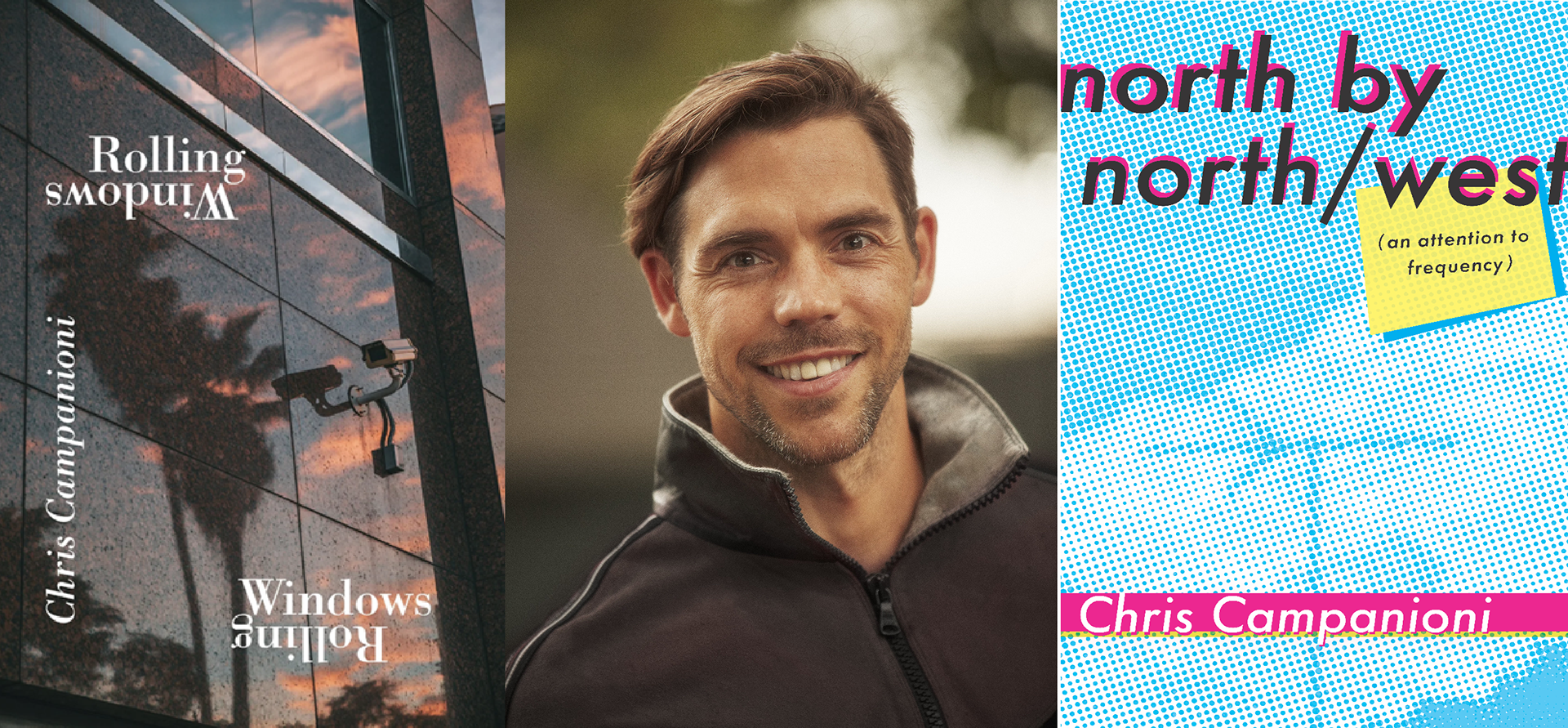
Luke Rolfes: It’s a pleasure today to talk with writer Chris Campanioni, author of many stunning books of different style and genre. I can’t thank Chris enough for taking some time with us today to discuss writing process and his most recent books.
Before we jump into the texts themselves, Chris, I wonder if I might ask a general question about you as a writer. As I get older, I think less in terms of genre and how we label writing. If pressed, I might define your work as “hybrid,” but I am not entirely sure if that is the right label in my mind. I might just say, “Chris is a writer.” How much (if at all) do labels matter to you and your work? Does it help in generation to think “I am writing a poem” versus “I am writing a hybrid essay”? Do you think about genre and labels at all when you write?
Chris Campanioni: I think labels are mostly helpful for readers, right? A kind of legend with which to access the text—or, for publishers and distributors, in order to sell it as such. I think of everything I write as “a poem” or maybe as “a notebook,” since that’s the textual mode where the actual writing occurs, or at least originates,
and so the residue of that form lingers there, it conditions what follows. I’m generally not fond of origins, or at least I’m suspicious of them, so I don’t know why I am suddenly centering beginnings. Or if that even makes sense, what I just said now, because a beginning can’t be at the halfway point, at the center, it has to start at the start.
and so the residue of that form lingers there, it conditions what follows. I’m generally not fond of origins, or at least I’m suspicious of them, so I don’t know why I am suddenly centering beginnings. Or if that even makes sense, what I just said now, because a beginning can’t be at the halfway point, at the center, it has to start at the start.
But I do think it’s important for me, for any writer, to consider things like function. Like: what are the advantages of turning this story into a novel and not a memoir? How can I exploit different narrative frames, or the lineation of verse, or the rolling endurance of prose?
LR: Let’s start with Rolling Windows—your new collection out from Roof Books. Can you tell us about the genesis of this project? How long have you been building this collection?
CC: Yeah, unlike Windows 85 (Roof Books, 2024), which was written over such an abbreviated breath of a
summer, this second collection came together over several years, beginning in June of 2018, while I was
sitting in an airplane on a flight to Naples, en route to Catania, in Sicily. The summer before, I had embarked on this strange task to write letters to Walter Benjamin at the different points of his seven-year exile across France and Spain. Since Walter Benjamin couldn’t write back, I understood the act of reading his letters, the letters he wrote at these same coordinates, as a kind of writing, a way of replying to me from the past. Anyway, all of this to say, Rolling Windows, the title poem and the first of the poems in the collection to be written, became a way for me to entangle a lot of what I was thinking about in my scholarly work, especially my interactions with folks at refugees shelters and community centers, but also a broader theorization of the unstable relationship between originals and copies, the interactions and discrepancies that occur when a text migrates across sign systems. I think this is why throughout the book, as in a lot of my work, there is this desire to conflate subject positions, to intensify the question of who speaks. Elsewhere, I think I’ve described this strategy as tuning the text to the time, the temporal registers, of listening.
summer, this second collection came together over several years, beginning in June of 2018, while I was
sitting in an airplane on a flight to Naples, en route to Catania, in Sicily. The summer before, I had embarked on this strange task to write letters to Walter Benjamin at the different points of his seven-year exile across France and Spain. Since Walter Benjamin couldn’t write back, I understood the act of reading his letters, the letters he wrote at these same coordinates, as a kind of writing, a way of replying to me from the past. Anyway, all of this to say, Rolling Windows, the title poem and the first of the poems in the collection to be written, became a way for me to entangle a lot of what I was thinking about in my scholarly work, especially my interactions with folks at refugees shelters and community centers, but also a broader theorization of the unstable relationship between originals and copies, the interactions and discrepancies that occur when a text migrates across sign systems. I think this is why throughout the book, as in a lot of my work, there is this desire to conflate subject positions, to intensify the question of who speaks. Elsewhere, I think I’ve described this strategy as tuning the text to the time, the temporal registers, of listening.
LR: I’m of the opinion that a book will teach the reader how to read it. I’m struck immediately by the opening lines of the text: “the audience looks in thru the fourth wall: / but which you is I ?” These opening lines invite the reader to participate in the text, perhaps, or even collaborate with the writer. Can you walk us through your intentionality in opening the book in this way, and what role you want the reader to play in this text?
CC: I love this idea, your observation of the book as its own instructional manual. Windows 85 was structured around the idea of keyboard shortcuts and Rolling Windows’ table of contents is stylized as command prompts. For me, there is no text, not even the impulse of writing, the urge to write things down, without participation, the aspirational interactivity of another. I sometimes think, I don’t write to be read, but to be a reader, to be someone to be read to. It’s the easiest way to disappear, or at least the safest. If I can write in this way, I can switch places, I can assume the unassuming position of a passerby.
LR: I loved “barbarian.” There is a raw, straightforwardness to the prose of this piece as the speaker takes us between rumination, exposition, and scene. At the end, the speaker says, “I would ask if pain changes you, but it isn’t really a question, is it.” I’m curious: When writing a piece like this, are you thinking in narratives or are you thinking in associative ideas? Maybe more specifically: When writing in this style, do you privilege “storytelling” or do you privilege “language and image”?
CC: I feel like I’m always privileging language and image. The story emerges from those settings. My role—which is not so different from my role in the classroom, as an instructor—is only to gather things, to signal waypoints and intersections, to accumulate opportunities for exchange … for my students, or my readers, to meet up in a space. The way I experience things is by finding ways to bring things together. People too. In my excitement for connection everything becomes connected.
Most of Rolling Windows is written in prose, whereas the poems of Windows 85 were nearly all constructed in tight couplets or tercets, the shape of desire or the tension of assimilation, the internal conflict of becoming another. I knew I wanted the language to break down, through its presentation as form, and the hyper enjambment and lack of punctuation of that book were ways that I could formally ventriloquize the internet, or the experience of it, to kind of recreate a digital consciousness on the paper page. The brokenness of language that L=A=N=G=U=A=G=E poets were working toward in the sixties and seventies is today presumed; it’s been totally normalized; it’s almost passé. But still we open a book today and many of us expect syntactic cohesion, linear relations, a stable present, or at least an episodic past. Absent the advantages of mobilizing lineation, Rolling Windows tries to fabricate a kind of edgeless plane of networked simultaneity or copresence through dropping punctuation and blending tenses, plus the general sprawl afforded by prose’s stretching of the page. I think this is maybe another instance of the book teaching you how to read it, quite literally, in terms of the breathwork involved—like sheet music for moments to be read fast, very fast, as indicated by a sentence’s resistance to commas, the repetition of a phrase or its reversal, the driving chant of anaphora, paratactic habits, et cetera.
LR: Another favorite of mine is the title piece. It is broken up into many different sections that are labeled “v.1.1” all the way up to “v.30.1,” though not progressing linearly. I’m intrigued by how you labeled each section, as if they are versions or updates of the same idea/concept. Can you talk about your choice of organization for this piece?
CC: I’d mentioned earlier about creating the conditions for readerly interaction. I think the title poem is a good example of this; the versions that begin to accumulate don’t cancel out any given scenario but multiply their pathways. Whereas an update presumes to fix, resolve, or improve on an existing event or application, a kind of re-writing or writing over, these floating v’s—like the flickering voltage of potential energy—want to advance through diffusion, a spreadable media designed to be lifted and repurposed. Narrative modulates, proliferates; really, it disperses; readers can play hopscotch across the pages, complicating any experience of “story” as singular, but also curtailing the expectation of a destination: no ends, only appearances. I think that’s what I was hoping to signal with the title, too, to reflect the portable clutter, the piling up of surfaces from which to jump, to arrive without ever having landed. & behind this window/another window …
LR: A wonderful passage from “the juxtaposition of foam” goes like this: “Years ago, the story about a Vietnamese farmer, wanting to hide from the rain, who found a hole and crawled in, only to find that the hole was endless. He kept crawling. What do I want to say about it? Nothing, except for a certain pleasure in passing. Wanting to alight upon the memory of receiving it, wanting to reprint the sound and cadence of its reception, to redistribute it, to turn this peculiar image into a set of words, to make it more familiar or more unfamiliar, to organize it across a strip of paper. To share that story with you. / Someone (my imagined reader) asks, That’s all? / And I reply, That’s everything.” This piece, to my ear, details a rationale for writing and the importance of trying to make sense of one’s existence and surroundings. Was the original intent of this piece to explore the concept of writing, or did you end up there organically?
CC: In an earlier version of Rolling Windows, “the juxtaposition of foam” was the collection’s final poem. I’m
not sure if my intention was to synthesize the ideas and energies propelled by the pieces that preceded it or rather, as you observe here, to introduce a kind of retrospective rationale for the book, for its politics and aesthetic allegiances. I think this is also where my methodology—of working on several books at the same time—comes into play in the sense that this poem takes a much more pronounced essayistic turn than many of the other prose pieces in the book, such that it almost found its way into north by north/west (West Virginia University Press, 2025), given its tempo and tenor, its distribution on the page, similar to how the unbroken blocks of “barbarian” nearly became a chapter in my recent novel, VHS (CLASH Books, 2025), whose chapter titles are all taken from movies. I like thinking of Rolling Windows as a nexus between several other books, and how the intermedial nature of the poems themselves exercise this combination of bookmaking and writing in general. The end-to-end process where the writer takes on different roles as the work progresses—Benjamin’s 1934 vision of “Author as Producer”—is always in the background as a series of rolling windows.
not sure if my intention was to synthesize the ideas and energies propelled by the pieces that preceded it or rather, as you observe here, to introduce a kind of retrospective rationale for the book, for its politics and aesthetic allegiances. I think this is also where my methodology—of working on several books at the same time—comes into play in the sense that this poem takes a much more pronounced essayistic turn than many of the other prose pieces in the book, such that it almost found its way into north by north/west (West Virginia University Press, 2025), given its tempo and tenor, its distribution on the page, similar to how the unbroken blocks of “barbarian” nearly became a chapter in my recent novel, VHS (CLASH Books, 2025), whose chapter titles are all taken from movies. I like thinking of Rolling Windows as a nexus between several other books, and how the intermedial nature of the poems themselves exercise this combination of bookmaking and writing in general. The end-to-end process where the writer takes on different roles as the work progresses—Benjamin’s 1934 vision of “Author as Producer”—is always in the background as a series of rolling windows.
LR: I wrote a couple passages from your book onto my notebook. “I was performing myself, I said, being myself” and “Did I mean story or did I mean life?” Both passages imply that we (at times) have trouble differentiating what is performance and what is self, what is reality and what is narrative. As well, the theme of technology creeps in and out of this book. I can see how our tech-heavy existence shapes and re-shapes our sense of identity and self. What are your thoughts on technology and how it alters our perception of self?
CC: I love your note on transcribing here, of copying things out onto the pages of your notebook, because I
think there’s something inherent in that process of remediation that speaks to your concerns about our shifting sense of self. I often ask my students to write about who they are when they write; where do they go? And can we recognize that person, when we read ourselves back, or is there some level of unfamiliarity, some distance that we find useful or necessary or maybe alienating, or maybe all of them unequally? But also, more generally, what happens to our world—not just our inner world but the world observable to others—when we begin to write these things down; how does the writing act, the simple act of copying something out, how can that fundamentally alter our experience of being in the world? So I like this confusion very much, between “reality” and “narrative,” because once you start copying things out, annotating your life as if it were any other text, is there really any difference?
think there’s something inherent in that process of remediation that speaks to your concerns about our shifting sense of self. I often ask my students to write about who they are when they write; where do they go? And can we recognize that person, when we read ourselves back, or is there some level of unfamiliarity, some distance that we find useful or necessary or maybe alienating, or maybe all of them unequally? But also, more generally, what happens to our world—not just our inner world but the world observable to others—when we begin to write these things down; how does the writing act, the simple act of copying something out, how can that fundamentally alter our experience of being in the world? So I like this confusion very much, between “reality” and “narrative,” because once you start copying things out, annotating your life as if it were any other text, is there really any difference?
LR: Let’s shift gears and discuss north by north/west, a book I would describe as more essayistic. How do you think about these two books in relation to each other, and if/how they connect?
CC: Oh yeah, it’s funny—I have a manuscript I’ve been working on throughout the last several years called
“ms dos,” as in the outdated operating system but also “manuscript two” to reflect the idea that these poems were written while conducting fieldwork for my dissertation, so that one might approach “ms dos” as a kind of secret text, the field notes or notebook underneath the text proper, the monograph that eventually became Drift Net (Lever Press, 2025). But I feel like this idea of a sibling ms, a counterpart or cousin, could also characterize the relationship between Rolling Windows and north by north/west, because they both are interested in pursuing a diasporic subjectivity, and they both do this—through different methods—in the way their formal presentations become a self-conscious enactment of their content. So what follows in north by north/west isn’t just a story about a narrator who plans to remake an Alfred Hitchcock film from 1959 until they see their double on the street and everything turns sideways, or an essay about the multiple and recurring consequences of Cold War colonialism, or a memoir about family accounts of exile and transgenerational dislocation, but the shaping of a methodology for persons on the move.
“ms dos,” as in the outdated operating system but also “manuscript two” to reflect the idea that these poems were written while conducting fieldwork for my dissertation, so that one might approach “ms dos” as a kind of secret text, the field notes or notebook underneath the text proper, the monograph that eventually became Drift Net (Lever Press, 2025). But I feel like this idea of a sibling ms, a counterpart or cousin, could also characterize the relationship between Rolling Windows and north by north/west, because they both are interested in pursuing a diasporic subjectivity, and they both do this—through different methods—in the way their formal presentations become a self-conscious enactment of their content. So what follows in north by north/west isn’t just a story about a narrator who plans to remake an Alfred Hitchcock film from 1959 until they see their double on the street and everything turns sideways, or an essay about the multiple and recurring consequences of Cold War colonialism, or a memoir about family accounts of exile and transgenerational dislocation, but the shaping of a methodology for persons on the move.
And I think that instructional quality—I say “instructional” but I don’t think of it is prescriptive or didactic—became really important to me in the making of the book; it’s something I often spoke about with my editors and publisher at West Virginia University Press. “Whatever it is, ultimately it teaches us how to read it; it shows us why it necessarily proceeds as it does and the makes us part of the process,” is how one of my first referee-readers, Christine Hume, describes the text, which returns to your earlier ideas about a book teaching readers how to read it. In this way, I think north by north/west is such a generative text for the classroom, because one can approach it as a book of literature and a book of theory but also as a craft book for writers and instructors, something that opens up the act of writing for others. And I feel like my favorite responses I’ve received from readers once the book was published was just this: that reading the book made them want to write!
LR: I’m curious about how you built north by north/west. Can you walk us through your generative process? What is it about the Hitchcock film that makes you come back to it again and again through so many different lenses?
CC: I hadn’t actually ever watched the film before, so I began writing north by north/west in the midst of watching North by Northwest for the first time. And it’s that sense of discovery, but also uncertainty—as though I didn’t know what would happen next, because I didn’t—that I hoped to have retained in the book, which is how I always want to write anything, by gardening rather than through architecture. I think a lot of my life has been about nurturing opportunities for coincidences, and I think that’s true, too, of the books I write or want to write. The idea of rewriting or repeating a previous chapter or sequence—this is how I originally thought of the chapters, as successive though discontinuous iterations of a moment—was inspired by an inkling that if I could write while watching, I would need to also keep rewinding, to return to moments, to linger on them, to expose them to an unnatural elongation, to make a second lengthen. So I built—I love this word you use—I built north by north/west in that piecemeal fashion, where every return had a slightly different starting point, given the tenuous nature of resuming anything—what became interesting to me was the hiatus. And how I might attend to that, those moments where I looked up, where I looked away from the film, the text.
LR: The thing I appreciate most about this book is that I feel like I am getting an unfiltered look into a writer’s consciousness and the nimbleness of a writer’s associative thought. Do you feel you write similarly to how you think?
CC: Oh, I love this idea—an aspiration—to write as one thinks, which is something that I think other writers have taken up, the most recent example I can think of is Jared Joseph’s incredibly slippery Soft Lighting, which Bench Editions published just a few months ago. In class, on the first day of one of my classes, a student of mine who had I guess looked up some of my work before we’d all met in person, said that he thinks that I write like I talk, and I like that a lot too, this notion that we might retain the cadence and energy and provisional quality of conversation in our written words. In a different book, which came before all of these, I write: What I want is a book as pure as talk. To seek out the interruption. To enter into or overhear in passing. I write so I may eavesdrop. So I may drop in or dribble out. Almost shamefully. But that book, which is called A and B and Also Nothing (Unbound Edition, 2023/Otis Books | Seismicity Editions, 2020), originated as a talk, literally as a seminar presentation that became a conference performance that became a book, and a video, too, at some point between all those other transitions. So maybe it’s easier to write this way if you don’t initially start off with the intention to write a book, but rather to create a life, something that could become anything else. Which is something I’ve been thinking a lot about lately, because now I’m also a dad.
LR: This is an interesting passage early on: “To ask questions, too, of the text, asking my students as I’d once asked myself whether one shouldn’t only think of themselves as a writer but as a DJ and an architect, and a videographer and a barber and a sous chef and a masseuse and a tailor, too; whether we should not examine creative practices and methods of production in isolation but account for how our writing and reading draw from sensory modalities that are not always privileged or legible within the departmentalization of knowledge, and perhaps more specifically, the offices of communication; whether it wouldn’t be best, after all, if we thought of writing as an occasion to think, and not the other way around.” I find myself reaching a similar conclusion as we live in a time where AI is celebrated and curiosity/intellectualism is scorned—that writing/reading are, more than anything else, vital exercises in thinking that are now under existential threat. Are your thoughts on reading/writing somewhat in response to the climate we live in right now?
CC: I like that moment a lot too. The sequence from which that passage comes was written much later, after
almost everything else in the book, but it became a kind of lodestar for the project—similar in this sense to “the juxtaposition of foam” for Rolling Windows—signaling so many of those instructive elements we’d talked about earlier, creative prompts and seminar interactions with students written into north by north/west’s absorbent fabric. Every day, more and more would-be writers make the choice to outsource their thinking and feeling to AI. Probably the most recent example is Nobel Prize-winner Olga Tokarczuk. Earlier this month, in May, it came out that a book called The Future of Truth: How AI Reshapes Reality (distributed by Simon & Schuster) contained fake quotes and erroneous sources assembled by AI. In response, the book’s author, Steven Rosenbaum, told the New York Times that the whole ordeal could be taken “as a warning” about his book’s subject matter. Students have told me that they are aware of their own need—a compulsion—to authenticate their own perspectives and ideas by running them through AI. Only then do they feel confident to submit the work they’ve been writing, or replace the latter with its deadened representation. The other day I heard another writer tell another writer: “Why would I do that? That’s like going on a date and then hiring somebody to have sex for you.” Which I think is the best metaphor for an enervating technology that trades encounter and sensation for flat and fabricated clarity, the drive for achievement without experiencing any of it.
almost everything else in the book, but it became a kind of lodestar for the project—similar in this sense to “the juxtaposition of foam” for Rolling Windows—signaling so many of those instructive elements we’d talked about earlier, creative prompts and seminar interactions with students written into north by north/west’s absorbent fabric. Every day, more and more would-be writers make the choice to outsource their thinking and feeling to AI. Probably the most recent example is Nobel Prize-winner Olga Tokarczuk. Earlier this month, in May, it came out that a book called The Future of Truth: How AI Reshapes Reality (distributed by Simon & Schuster) contained fake quotes and erroneous sources assembled by AI. In response, the book’s author, Steven Rosenbaum, told the New York Times that the whole ordeal could be taken “as a warning” about his book’s subject matter. Students have told me that they are aware of their own need—a compulsion—to authenticate their own perspectives and ideas by running them through AI. Only then do they feel confident to submit the work they’ve been writing, or replace the latter with its deadened representation. The other day I heard another writer tell another writer: “Why would I do that? That’s like going on a date and then hiring somebody to have sex for you.” Which I think is the best metaphor for an enervating technology that trades encounter and sensation for flat and fabricated clarity, the drive for achievement without experiencing any of it.
LR: You mention this: “The books I like least are the ones that are too certain, too comfortable or clear about their own position and the conditions for the ideas they contain. The books I like least are rehearsing; the author rehearses the ideas they’ve already understood; the text tries to transmit a kind of understanding, which is knowledge, veiled in an argument. What I want is to try to work things out, and to be clear that I am (only ever) uncertain about the conditions for the work, which are always changing (just as I am), the thoughts and feelings I am only recognizing now (later) or that remain unrecognized by/unrecognizable to me.” As well, you push back earlier against the idea that writers should “write what you know.” Do you think that writers are writing less “to discover” in the current literary landscape? If so, why?
CC: I mean, I read a lot and I’ve read a lot of wonderfully inventive, curious books over the last few years, so
I hesitate to say that writers today are not writing “to discover” but I do think that well before the voice of Large Language Models infected our psyche, the market economy of literature dictated a kind of story and a kind of storytelling, a kind of voice and a kind of author to tell it, and that’s probably even more true today given the increasing consolidation of publishing; prose and poetry are not immune to what happened with media conglomerates through convergence culture a decade ago—so what gets exported is not a writing to discover but a writing for discovery. Even independent presses who have found success by taking risks and who have grown rapidly as a result can no longer afford, in this climate, to continue publishing work that has no legible precedents, the comparative titles that remake work in their streamlined image. As a result, I think more and more writers are looking to university presses as an antidote to industry formula. It’s one of the reasons why I was drawn to working with the folks at West Virginia University Press on this particular project.
I hesitate to say that writers today are not writing “to discover” but I do think that well before the voice of Large Language Models infected our psyche, the market economy of literature dictated a kind of story and a kind of storytelling, a kind of voice and a kind of author to tell it, and that’s probably even more true today given the increasing consolidation of publishing; prose and poetry are not immune to what happened with media conglomerates through convergence culture a decade ago—so what gets exported is not a writing to discover but a writing for discovery. Even independent presses who have found success by taking risks and who have grown rapidly as a result can no longer afford, in this climate, to continue publishing work that has no legible precedents, the comparative titles that remake work in their streamlined image. As a result, I think more and more writers are looking to university presses as an antidote to industry formula. It’s one of the reasons why I was drawn to working with the folks at West Virginia University Press on this particular project.
LR: I am intrigued by the images juxtaposed throughout these texts. You say, “I don’t write books anymore, I write combinations.” Perhaps this is the simplest way to describe the almost “collage-like” style of this book. What made you start to think of your writing in this way?
CC: Oh, I love your reading of that line—one of my favorites in the book—alongside the text’s formal composition. The use of white space and photographs mimic the “windows” of our everyday browsing habits, which is another link, something I hadn’t thought of but must have been in the back of my mind while writing these two books together. I always tell students that writing should be conditional; this is why we revisit the same prompts we conduct together in class, which is why repetition never yields the same result. So I like cutting into that hole, deepening it, and it became empowering, I guess, to acknowledge that this book is just one combination among several others that lived inside or underneath the text in its many states or stages of being played, of being played with. In this way, writing a book is not unlike taking a photograph; you freeze a version, but the text, or life, continues moving, without and in spite of your intervention. I like the idea that characters and voices and objects and things live on and beyond the pages of the books they find themselves in.
LR: I loved “we the people.” A memory of a photograph featuring a bottle of Malta triggers a contemplation of place and the construct of history. The wide-canvassed, tour de force “a second (sequence) >” appears immediately before “we the people,” yet “we the people” is smaller and contained. What instinct did you follow that led you to keep this piece concise?
CC: This is such a great question. I guess I’ll speak a bit about curation and arrangement, which seems already engrained in the fabric of the book, given its affinity for collage. A dear friend and mentor of mine once told me, when I was a student in their classroom, that I might try to attain more high points in the text. So I always try to draw from other art forms and find out how. I think there are ways we can achieve these high points—increasing the frequency of emotional beats—through continuously reordering the text and playing it back, as if it were a mixtape. I also think I was probably being mindful of just how prolonged “a second” appeared on the page—at nearly one hundred pages, it is by far the longest chapter—and I wanted to interrupt or divert that gallop, to insert something much shorter, much more cohesive, almost self-contained, as you say—an essayistic refreshment for readers—hoping to stage a series of intervals or intermissions within the text, lest it become too regular and steady.
LR: I’m fascinated by “what is a title page?” In it, you say, “The shrouding of women in the field of translation informs the general obfuscation of the translated work as a translation, a promotional oversight that suggests a contradictory perspective: we value a work of art less once it has been passed through translation; we value a work of art more once it has been passed through translation—to the extent that the translation of an original adorns it with new life, but also, as Goethe foresaw, new literary value.” You go on to talk about how language and the stripping of language is incredibly powerful. Can you talk a bit more about that idea of obfuscation and the stripping/repurposing of language?
CC: I always say “I don’t want to be prescriptive” and then say something that might endanger that proposition. Among my concerns regarding translation is a common lack of transparency, what you observe here as a categorical obfuscation. In Drift Net, I spend a lot of words trying to flesh out an ethics of translation less concerned with fidelity than transparency; of showing translation’s fallibility and the several different actors involved in its production. What becomes apparent are the power relations inherent in any act of translation, not just literary translation but legal translation, the material conditions of subject-authors and the hypermediated process of sharing, telling, reception, and interpretation. What I want to privilege are the steps, detours, digressions, and mistakes—the processes of rendition that are often hidden, erased or washed clean. So “what is a title page?” permitted me the opportunity to revisit these issues and to do so through a focus on the gender dynamics of authorship and the specific omission of women in translation and as translators.
LR: I’d love to hear about any new projects in the works. What are you up to currently?
CC: I’m always juggling, I feel comfortable with a lot of balls up in the air. I have a work of prose—I’m calling it “docufiction”—that is also maybe secretly a book-length essay on logistics, faces, and biometrics titled “Rough Trade” that I’ve just started submitting to editors. And I think it’s a good demonstration of how I
make things more generally. The novel began as a conversation for The Brooklyn Rail, and then became a talk, or “anti-lecture,” at the Center for Humanities, and then became a keynote presentation for FDU over in New Jersey, and then it became my class “Holes and Surfaces.” I love the idea of a novel also being a seminar also being a syllabus also being a talk that coincidentally provides the ground situation for the fiction to unfold. That a book can be all of these things is maybe my larger point.
make things more generally. The novel began as a conversation for The Brooklyn Rail, and then became a talk, or “anti-lecture,” at the Center for Humanities, and then became a keynote presentation for FDU over in New Jersey, and then it became my class “Holes and Surfaces.” I love the idea of a novel also being a seminar also being a syllabus also being a talk that coincidentally provides the ground situation for the fiction to unfold. That a book can be all of these things is maybe my larger point.
Another project—perhaps more conventional?—is a work of creative nonfiction called “The Great Forgetters” that collages classwork with students, the letters to Walter Benjamin back in 2017, craft essays, and family archives. Because of the multilingual nature of the project and the fortunate circumstance of having several of the essays published in translation, there’s an incredible story about my father and his grade school classmate in Oriente, who read an excerpt in Latin American Literature Today and connected with me over email to get in touch with my dad, whom he later mailed photographs and other documents belonging to him—stuff my dad hadn’t seen in over sixty years, things he was unable to take with him as a child when he fled Cuba with a single suitcase. I wrote about the day my dad opened the mail and rediscovered parts of his childhood, and that essay will be published in a few weeks in The Tampa Review. So this kind of reflects the real-life gift of translation, the text giving back but also occasioning the conditions for other texts to emerge.
I have another book in the works—an autoarchival companion to A and B and Also Nothing called Vanish Mode, which Unbound Edition will publish in the fall of 2027. What excites me is not just the text itself—a favorite essay from the book called “The Spell of Exile” appears in The Offing—but how Patrick Davis has reenvisioned the mode of publication. The text—alphabetical text, images, and sound—will be published episodically and “out of order” across platforms before the paper version is printed. In our discussions, Patrick likened this approach to a streaming of sentences and chapters that disappear after a week, gesturing to the early form of novels produced in serialization but also enacting the vanish mode of the book’s title as a countdown to print publication.
Unbound is also trying to time much of this with a “# Edition” of A and B and Also Nothing, for which I’ve
written a foreword. I’m generally very preface averse but 2027 will mark ten years since I first composed
the text, in its earliest version, so I’m excited about celebrating the people and attending to the conditions which made my writing possible. The hashtag of the subtitle indexes, like the Twitter of old, the aggregation of collective voices, a nod to the hospitable and promiscuous disposition of a notebook but also a way to commemorate A and B and Also Nothing as a kind of perpetually mobile, migratory text. Like its characters, I love a book that keeps going.
written a foreword. I’m generally very preface averse but 2027 will mark ten years since I first composed
the text, in its earliest version, so I’m excited about celebrating the people and attending to the conditions which made my writing possible. The hashtag of the subtitle indexes, like the Twitter of old, the aggregation of collective voices, a nod to the hospitable and promiscuous disposition of a notebook but also a way to commemorate A and B and Also Nothing as a kind of perpetually mobile, migratory text. Like its characters, I love a book that keeps going.
LR: Thanks so much for your time, Chris! You can check out Chris’ new books here:
https://www.roofbooks.com/rolling-windows
https://wvupressonline.com/node/987
https://www.roofbooks.com/rolling-windows
https://wvupressonline.com/node/987