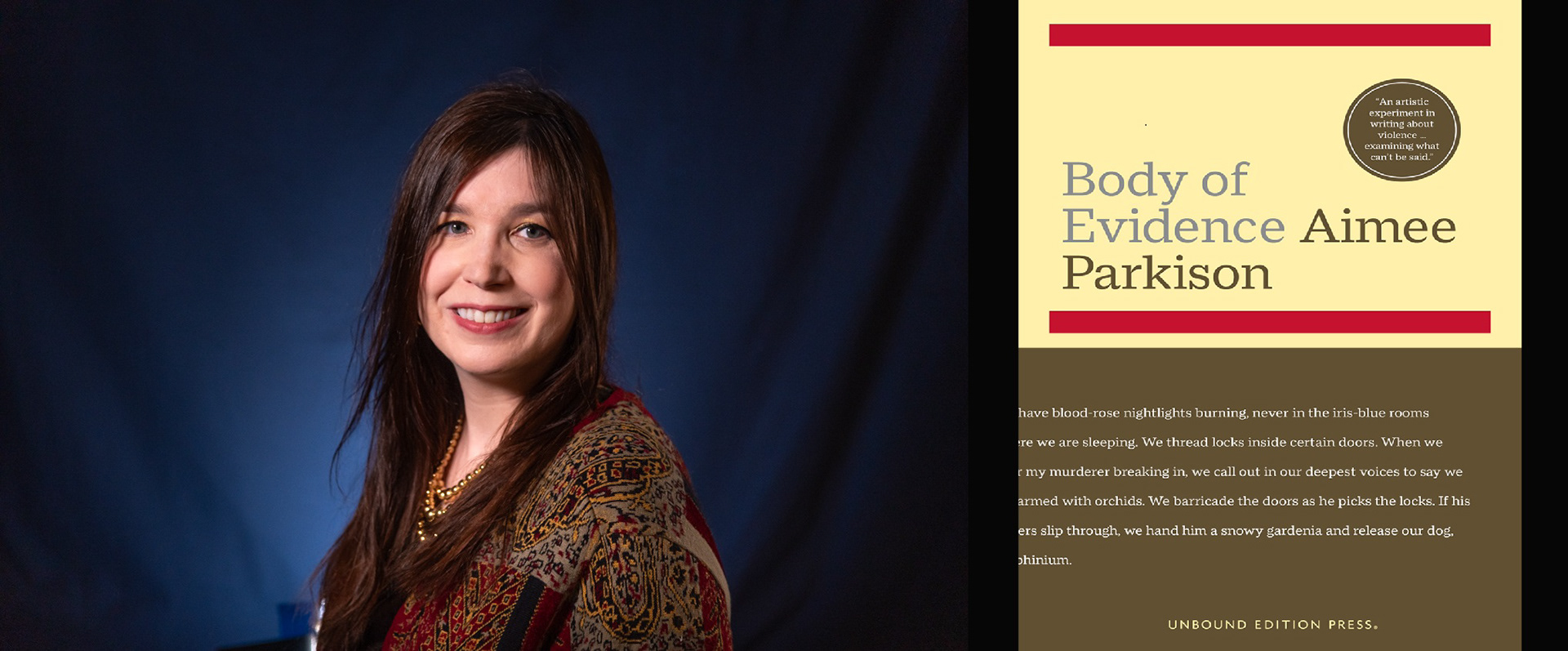
Luke Rolfes: We at Laurel Review have been long-time fans of the work of fiction writer Aimee Parkison. We’re here today to talk about Aimee’s brand-new collection of short works entitled Body of Evidence, out now from Unbound Edition Press. This book is a tremendous collection of realistic and speculative micros, all revolving around the topic of gendered violence and trauma. Thanks so much for taking some time with us, Aimee, and congrats on your recent successes!
Aimee Parkison: Thanks, Luke. I appreciate your support and the support of The Laurel Review!
LR: Where did you get the idea for this Body of Evidence project, and how long has it been in the works?
AP: Body of Evidence was in the works for around three years. The project was under contract while I was writing the book. The subject matter is something that I’ve been writing about for many years, but the idea for the book came when my editor at Unbound Edition, Patrick Davis, invited me to write about the topic in a longer format after reading several of my shorter pieces on the theme. My writing on the project took part in stages:
—Research on major American crimes and criminal lore, including historical violence against vulnerable individuals and Hollywood depictions of violence
—Writing fiction around the research by focusing on everything except the acts of violence
—Writing more formal drafts from the above materials and shaping freewriting and journal entries into micros and flash fictions that reveal narratives through the unspoken
—Numerous drafts to shape the writing, creating a narrative web among micros by arranging them thematically as a collection
—Revising, editing, and proofing the collection before sending the early draft to my publisher to then start the collaborative process of editorial and book design.
LR: This book is presented as 23 different “exhibits” or evidence case files. I love the unique organization and how Unbound Editions chose to represent the cover of each section with different colored paper. How did you decide on that organization and how to present it? Was it a collaborative effort with the press?
AP: The micros in the collection fall into categories: witnesses and survivors of many types of violence against women, girls, and the vulnerable throughout American history; the toll violence takes on survivors and those who love them, what remains unspoken between parents and children, the way emotional scars heal and yet remain, the lonely people who are left behind and have something to say about their isolation.
The press and I wanted a design to fit the content. The idea for was for the colors of the book cover to be the colors of criminal evidence “case files”—manilla evidence folders with red tape and black type—and each section divider to look like a case file. My editor, Patrick Davis, hired a book designer after we started down that conceptual pathway. Collaboratively, we worked on the design.
LR: You regularly publish flash/micro and short fiction in literary journals, and I’m curious about the process of culling your own work for a collection such as this. Could you talk broadly about your process of content generation? Did you look for similarities in your previously written stories, or did you write works specifically on the theme of gendered violence?
AP: The book was written with the intent and artistic theory that avoiding actual representations of violence would make the realities of violence against women more disturbing and real to the reader by showing the victims’ perspective in the aftermath of attacks, since our culture has been so desensitized to graphic violence in art.
As a survivor of violence, I wanted to unite with stories of other women, with historical events or lived experiences of many women. For that reason, my prose weaves in and out of the concrete “real” of traditional realism by questioning the mindset and culture of a society driven by violence against women and girls.
The book explores abusive relationships and complex messages about power whispered to women and girls. One theme it examines is why some people remain silent and what silence means in the face of survival. When it came to my process, I leaned into the idea that silence is subtext.
Weaving hybridity of form and genre, the line between fiction and nonfiction, the line between story and conversation, and the line between narrative and confession are crossed, blurred, or erased.
LR: You say this in the introduction, “While the seeds of these stories were sometimes gleaned from actual researched events, the resulting pieces are narrative journeys that grew from these events to explore what remains unspoken in the generational echoes of trauma’s aftermath.” Because the world in which these narratives exist is so flawed, convoluted, and warped by things like rape culture and recursive trauma, how does that shape the way you craft pieces in conversation with this world?
AP: I used a rippling effect to show how violence creates trauma that moves through generations and through time. Like a stone thrown into a still pond, the ripple keeps moving outward, touching all the water and drifting back before it stills. To do this, I had to work through an attacking incident, an attacking sentence (the stone) held by constraint (the still pond). I found compression in the short form to be a productive method of constraint, allowing for a deep and sudden experience but also allowing the reader to rest between pieces. The short form has urgency built into its compression.
LR: Oh, wow. I love that metaphor of a stone thrown into a pond. Kind of a follow up to that: What inspired you to blur the boundaries between speculative and realistic fiction and creative nonfiction in this book? Is it partly influenced by the “messy reality” in which these stories exist?
AP: In my writing, I’ve often hoped that art could create empathy by opening the audience’s mind to the struggles of others. If empathy for characters is related to their accessibility, writing characters who are victims of brutal, dehumanizing attacks is a risk because of the dehumanizing impacts of violence, which makes victims inaccessible to society, as most people do not understand the impact of violence on victims in their community. Experimental fiction often lacks the transparency of traditional fiction. I’m interested in exploring how the categories of traditional versus experimental apply to female characters who have suffered the dehumanizing effects of brutality in rape, domestic abuse, and attacks in occurrences so disruptive to society, so frightening, threatening, or unacceptable to society, that the victims are silenced or ignored.
LR: As a fiction writer, you’ve written everything from incredibly short to long-form prose. Your last book, Suburban Death Project (also from Unbound Edition Press), featured more traditional-length short stories, and I believe the one you published before that was a novel (Sister Séance, Kernpunkt Press). Can you talk about “the micro” or “flash” as a canvas for story? What draws you to this form, and why did you utilize it so often in Body of Evidence?
AP: I write to explore overlooked voices and complex characters, opening doors to unusual journeys through language in a variety of forms. My characters are often victims or perpetrators of violence, "difficult women," or fated lovers whose happily-ever-after ends in abiding love that will not release them.
As a canvas for story, compressed forms such as micros and flash are often voice-driven and operate on implied narratives rather than on overt, traditional narrative techniques. I like leaning into the subtext of the implied narrative.
In this collection, I was drawn to the micro form because of its compression and restraint. Dealing with such an emotional subject matter, I found it more impactful and merciful to work in an extremely short form.
LR: About ¾ of the way through this book, I wrote this down: “The images and motifs in this text swirl and circle in this collection, almost like a tornado of influences that are all part of the same storm.” Are these echoes and connections between pieces intentional, or do they occur naturally when you focus on a particular topic?
AP: Echoing, swirling, rippling, tornado cycling of sentences, images, and motifs occurred in the writing of these stories because of the subject and tone. Trauma is a trap because it repeats in the mind. Those who have experienced trauma live through the cycles of the mind, and what happens to the body can create echoes in the mind. That mind-body connection and the cycling became a voice that owes a lot to Gordon Lish’s concept of recursion, where what comes next is always behind you. For me, this is very similar to the exploration of gendered violence and the body when it comes to experiencing trauma.
The echoing, swirling, rippling, cycling are part of my use of nonlinear narrative forms while exploring the connection between suffering and survival, secrets shared by generations constantly echoing, swirling, cycling, rippling through all our lives, whether we realize it consciously or not.
LR: Silence is a major theme of this text—things left unsaid or unheard. What drew you to this theme?
AP: The book started with a micro series I wrote entitled “Lethal Conversations.” One of these micros is about a nightshift nurse who speaks to female patients recovering from a senseless, brutal attack and tries to explain to them what has happened when they go in and out of consciousness.
I was invited by Unbound Edition to write this collection based on that story’s vision and concept of “lethal conversations” as nonlinear narratives of unspoken traumas of fading and emerging notions of self, identity, gender, community, and country. I write about and explore how people admit what is difficult, saying what some think should remain unspoken and what society wishes would remain unseen.
LR: I’m curious about headspace. There are heavy plotlines (and real/realistic traumas) strewn throughout this collection. Almost all these characters deal with trauma and violence—often unspeakable trauma. How do you get into the proper headspace to enter these narratives? And do you have to be in a certain mood or mindset to enter them?
AP: My fiction portrays gruesome truths. The shocking revelations in my work, I feel, are compassionate yet inherently painful, beautiful, and contradictory.
Authenticity comes from sensitivity. That’s the mindset I operate from when I write. That’s what makes art powerful and dangerous. Creative risk is the same risk as with extreme intimacy. To be an artist—a creative writer—one must be open and remain open to pain and pleasure, ugliness and beauty. That’s what it means to create a character, a mood, a voice, or a story that sings lyrically with pleasure, pain, joy, depression, sensuality, or fear—any real and deeply felt emotion that moves from the page to the reader’s heart and mind.
LR: I was struck by “Remember Me.” In this piece you used sequenced repetition, as the protagonist in a psychiatric unit tries to re-establish her bearings. Can you tell us about this one and the craft choices you made with repetition?
AP: Writing this was like working through trauma. Recursion echoes like PTSD in the trauma-haunted mind. It’s a Gordon Lish way of crafting a narrative, where a single core sentence is so provocative it is an “attack.” But the word “attack” is complicated when I think of this project. When writing about violence, how can a sentence be an attack? Do I want my sentences to attack the reader? Will my writing be good if it doesn’t? Where does this take me as a feminist writer influenced by women and sentences, even in writing about violence and having to use the language of violence to discuss craft?
My writing swerves into subversion. If a sentence can dance, it forces you to look at it and to keep looking back. It haunts. It makes you look behind to move ahead.
LR: The section “Exhibit 22: Cotard’s Illusion: Walking Corpse Syndrome” contains interconnected pieces involving an impoverished family, a forgotten elevator, a Book of Screams, and the hypnotic Jane (who likes to roller-skate topless). It begins with a piece called “A Woman and a Girl Named Jane (a short play).” What inspired you to present this narrative in such a non-linear and kaleidoscopic way?
AP: This section moved like a cinematic montage in a surrealist horror film in my mind—moments, visions, sensations. Attacks came in waves. Whenever the violence was heightened, it swerved away to the implied. What was left was a nonlinear mosaic of narrative scar tissue.
LR: Some of these pieces discuss modern day predators: Larry Nassar, R. Kelly, Harvey Weinstein, and P. Diddy. Others discuss older, historical traumas and gendered violences, such as Gisele Pelicot and Elizabeth Short. Was it more difficult to write about the present or the past?
AP: The present and the past are both challenging for different reasons. The present lacks a certain perspective and distance since we’re still living it, while the past is so far away that it feels distant with too much context. Whether writing about the present or the past, a writer must find a way to locate the subtext of the narrative to make it new and alive while working through narrative distance. I find that to write about certain subjects, you must be bold, to allow yourself to feel something for the characters, to give yourself permission to write and to know that you are never going to get it 100 percent accurate. Life, memory, and trauma are too complicated for accuracy, even in memory and eye-witness accounts. There is no one “true” or fully authentic story because there are infinite perspectives. The only voice that can be accurate is silence because it says nothing and everything.
LR: There is a stunning “advertisement” in the middle of the book for a perfume called TERROR. What can you tell us about this section? Did you always imagine it having a graphical component?
AP: The perfume ad inside the book advertises a perfume called Terror, appearing in the section on scent and fear. While I imagined this graphical component as an experimental element of the story, the advertisement was created by professional ad designers hired by the publisher to mimic something that might appear in a fashion magazine.
The goal was to make the advertisement look convincing, to comment on the way that women are used to sell products that reference the male gaze.
Unbound Edition used this ad in an online campaign for the book but ended up having to pull the online ads because the ads were being misunderstood outside of the context of the book.
LR: Are there other texts, films, music, or art that were inspirational to you and the way you approached gendered violence that you would like to shout out?
AP: When it comes to horror movies that have inspired or moved me, the body horror films of David Cronenberg come to mind. Also, Rosemary’s Baby, The Exorcist, Suspiria, Red Rooms, Lake Mungo, Skinamarink.
My literary influences in writing this collection are many, such as:
Poetry: The poems of Sylvia Plath and Anne Sexton.
Fiction:
The Deep by Rivers Solomon
The Handmaid’s Tale by Margaret Atwood
Red Clocks by Leni Zumas
The Color Purple by Alice Walker.
Dorothy Allison’s writings, especially Bastard Out of Carolina.
Asking for It by Louise O'Neill
Beloved and The Bluest Eye by Toni Morrison
Non-Fiction:
No Visible Bruises by Rachel Louise Snyder
Our Bodies, Their Battlefields by Christina Lamb
The Last Girl by Nadia Murad
Here are some other great recommendations – 16 Books for 16 Days of Activism Against Gender-Based Violence | The New York Public Library
LR: That is an awesome list of texts! What’s next for you and your writing? Any new projects coming up?
AP: I’m working on many new projects at once, spinning voices, characters, and worlds. This is my typical process, juggling multiple new works-in-progress to see what develops. I also need to take breaks to get grounded, finding that translucent thread that connects the character’s heart and mind.
LR: Thanks so much for your time, Aimee. Body of Evidence is a wonderful book! Check it out at
AP: Thanks, Luke, for these insightful and challenging questions! Also, thanks for all that you and your team at The Laurel Review are doing to support the literary community, experimental writing, and independent publishing.
Bio: Aimee Parkison earned her MFA in Fiction Writing from Cornell University. Her work has won numerous national awards and fellowships, including North American Review’s Kurt Vonnegut Prize, and she has published over one hundred works in various journals and anthologies, including The Best Small Fictions. She teaches in the PhD/MFA at Oklahoma State University and is the author of eleven books, including Body of Evidence (Unbound Edition Press), Girl Zoo (Fiction Collective 2), and Refrigerated Music for a Gleaming Woman, selected by Stephen Graham Jones for the FC2 Doctorow Prize for Innovative Fiction.